
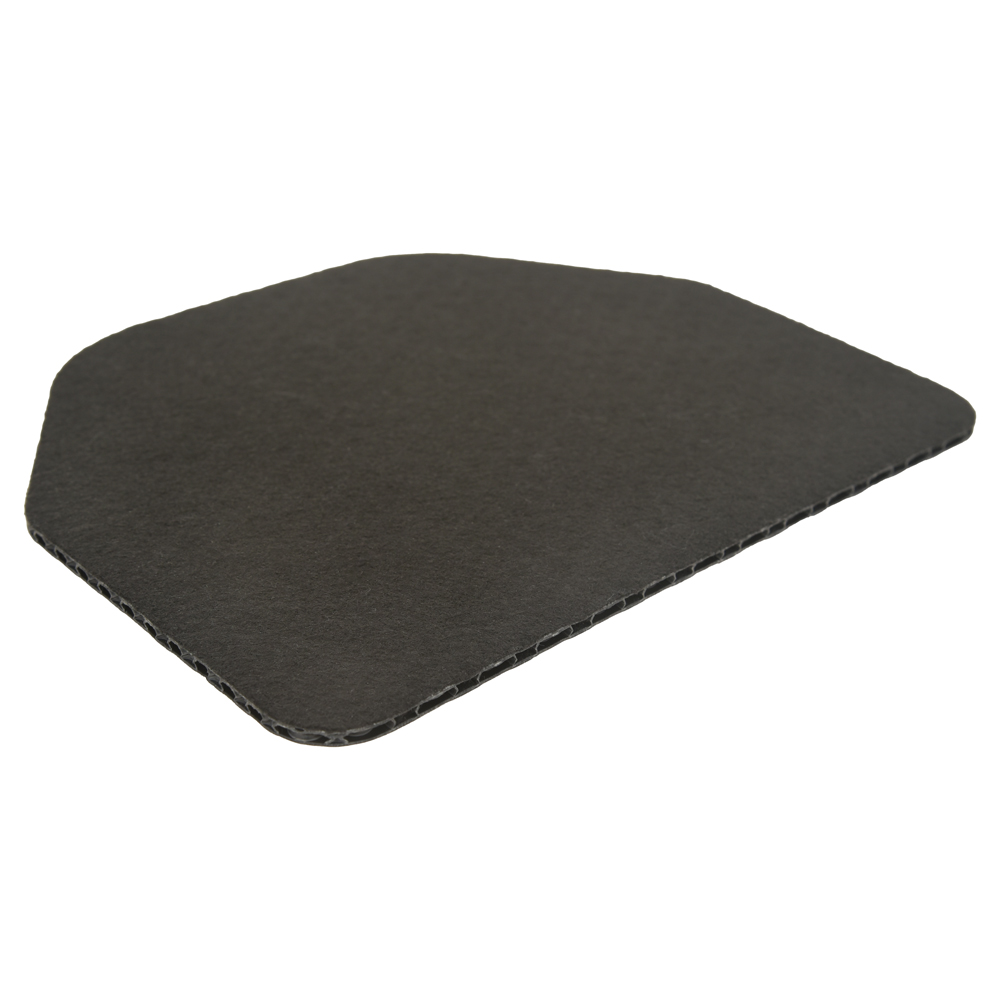
Appliance panels, glass fronts and finished metal faces arrive damaged from rubbing rather than from dropping. The load case is not weight, it is relative movement – two hard surfaces vibrating against each other for a few hundred kilometres.
The damage mode is abrasion, not impact
Structurally, most appliance packs are over-specified. Cosmetically they fail because faces rub. Any relative movement, however small, with any grit between the surfaces, produces scratches that reject the part.
So the packaging objective is to prevent relative movement and keep anything abrasive away from the finished face, in that order.
Separation beats padding
The instinct is softer padding. In practice a firm separator that maintains a consistent gap outperforms soft padding that compresses and then allows contact. Honeycomb panel separators work well here because they are light, rigid enough to hold an air gap, and have no loose fibres to scratch.
Edge protection is not optional
Chips start at edges and then the whole panel is rejected. Corners and edges need protection that stays in place through several handling events, which is where glued or friction-fit protectors fail and strapped-on angles succeed.
A panel separator with an integrated edge channel is usually worth more than its cost difference.
Weight distribution on the vehicle
Large flat loads are prone to resonant movement at particular road speeds and trailer lengths. Strapping that stops horizontal movement does not necessarily stop vertical bounce. Adding vertical restraint or increasing friction between layers is often the only change needed.
The reusable question for outbound appliances
Appliances mostly ship one-way to retailers or end customers with no return leg, which makes reusable separators a hard sell – they do not come back. Where reusables do work is in the inbound flow from component suppliers or between plants, and that is usually where the business case sits. We set out the arithmetic in building a business case for reusables.
Cleanliness matters more than expected
Any grit captured between separator and panel becomes a scratch generator. Reused separators must be inspected and cleaned, and rough handling on return that damages their faces turns them into the thing they are supposed to prevent. Damaged separators should be scrapped, not tolerated.
Load restraint versus surface protection
These two requirements genuinely conflict. Restraint wants firm contact and preload; surface protection wants clearance and no pressure on finished faces. Resolving it means separating the functions physically – restraint at structural points, protection at cosmetic ones – rather than expecting one material to do both.
In practice that means the restraint crosses the pack at defined load paths, and the separator maintains an air gap everywhere else. Designing that deliberately prevents the common failure where strapping is routed across a finished face because it was the convenient place.
Separator condition is part of the system
Reused separators with damaged faces become the abrasive they were meant to keep away. Inspect and retire them on the same schedule as any other safety-relevant component; a cheap separator that scratches an expensive panel has cost far more than it saved.
What we can do
We supply PP honeycomb panels as separators and layer protection for flat-product shipping, including with sealed edges and integrated edge channels. Send the panel dimensions, the transport mode and whether there is any return leg, and we will be straight about whether reusables are worth it in your case.