
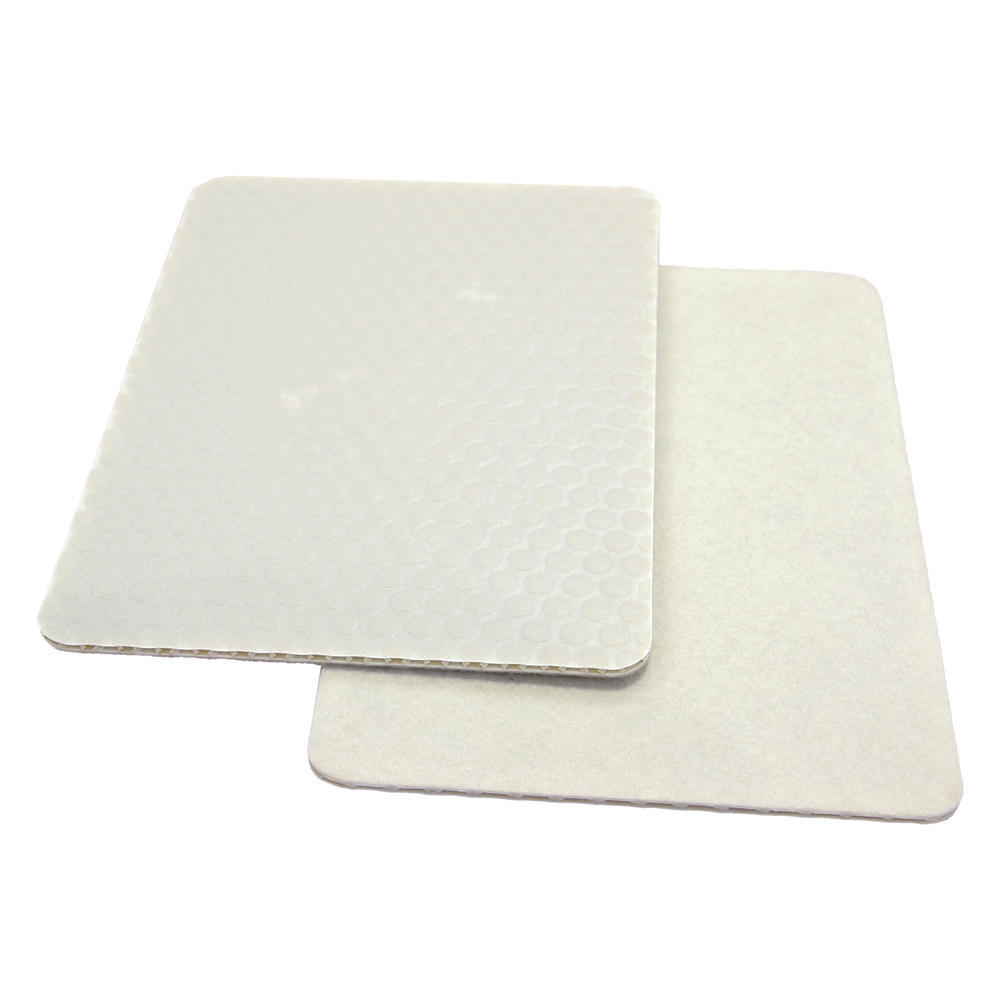
Somebody always wants to bolt something to a panel. Usually it is a wear strip, a castor plate, a sensor bracket or a handle. The default approach – drill a hole, put a bolt through, tighten – works for about as long as it takes someone to check it.
Why through-bolting struggles
Polypropylene creeps. Under a constant clamping load the material slowly deforms, the bolt loses preload, the joint loosens, and then the fastener starts to bear against the hole rather than clamp around it. Add vibration and the cycle accelerates. Separately, the bearing stress at the hole is the failure point in any event, regardless of preload.
None of this means bolts are wrong. It means the load needs spreading and the preload needs managing, and the inserts and threaded bushings available for PP panels are described separately.
Option one: through-bolt with backing plates
The simplest fix is a plate either side, spreading the bearing load over a large area. This is cheap, serviceable, and adequate for lightly loaded brackets. It does not solve creep, so the joint needs periodic re-tightening – acceptable if the panel is accessible and somebody owns the check, unacceptable if it is buried in a rack.
Option two: threaded inserts
Moulded inserts – heat-set, ultrasonic-set or expansion types – give a real metal thread and spread load through their flange or knurl. They are the correct answer where something gets removed and refitted repeatedly, because repeated thread engagement is exactly what destroys a tapped hole in board.
The installation method decides the holding strength far more than the insert itself. Overheating during heat-set melts a void around the insert that later becomes a pull-out; too little heat and the knurl does not fill. This is why the same insert performs differently fitted by two people.
Option three: bonded-in bushings
Where the panel face must stay flat and the load is moderate, a bonded bushing with a wide flange works well and costs less than an insert with tooling. Surface preparation is everything here, and polypropylene needs mechanical keying since adhesives bond poorly to it untreated. This is the same constraint described for threaded bushings in PP panel.
Choose by removal frequency
Fitted once and left alone: through-bolt with plates is fine. Removed a few times a year: expansion insert. Removed weekly: heat-set threaded insert. Removed daily: reconsider the design, because nothing in board likes that duty and a metal frame or extrusion is the honest answer.
Thread locker and torque
Never torque into board the way you would into steel. The failure is gradual and quiet – the material yields locally and the fastener settles. Low torque, wide bearing area, and a thread locker suitable for plastics (many standard formulations attack polyolefins or are too aggressive for the substrate strength).
Installation is where it fails
Most insert failures are installation failures: wrong temperature, wrong insertion depth, or an insert fitted into a hole that was drilled oversize. Any of those produce an insert that looks correct and pulls out under load, and no amount of specification change fixes a fitting problem.
Train once, keep a gauge for depth, and test the first and last insert of every batch with a simple pull. Those three steps are cheap and they catch almost everything, because insert problems are systematic rather than random.
What we can do
We fit insert systems into returnable sleeve containers and other fabrications, and will ask how often the fastener comes out before recommending one. Send the load and the removal frequency; if the honest answer is that nothing insert-based will hold, we will say so and suggest a reinforced boss instead.