
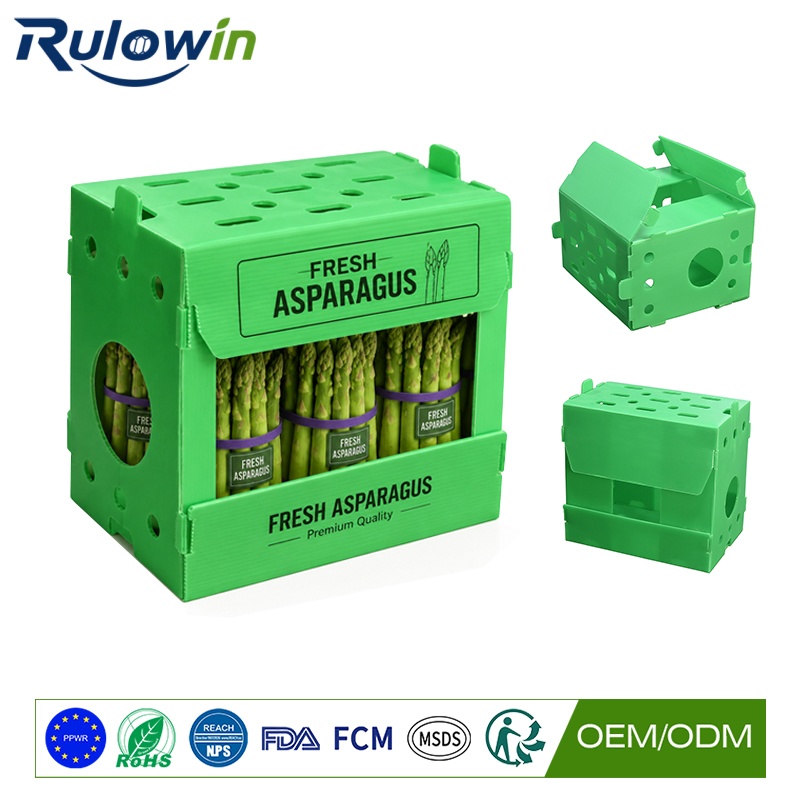
Produce crates come with several vent patterns and the choice is usually made on habit. Three things genuinely change with the pattern, and one thing that people assume changes does not.
What changes: airflow
Total open area is the number that matters for cooling. A pattern with a higher open area lets more air through the stack, which is why vented crates are specified for pre-cooling and reefer work in the first place.
Distribution matters as much as total. Vents only in the base cool slowly; vents in the walls cool through the stack. For anything that has to be cooled rather than just carried, wall vents are the ones to look at.
What changes: drainage
A crate that has been washed, or that carries wet produce, drains through the vents. A pattern with vents low in the walls and in the base drains well; one with vents only high up holds water at the bottom.
Held water is the problem, not the wet. A crate that stays wet after washing grows biofilm, and the base is where it starts.
What changes: what falls through
The aperture size sets the smallest item the crate can hold without a liner. This is the constraint for any non-food use and it is the thing to check first if crates are being reused for parts or components.
What barely changes: strength
This is the counter-intuitive one. Removing material from the walls does reduce stiffness, but in a crate of normal specification the difference between vent patterns is small compared with the difference between resin grades or base designs.
Which means: if crates are failing, the vent pattern is almost never the cause, and switching pattern to fix a strength problem wastes money. Look at the grade and at how the crates are handled first.
The vent-ratio terminology and how it is described on spec sheets is set out in crate terms: vent ratio and stack height.
Choosing one
Start from the crop and the process. Cooling-critical produce needs open area and wall vents. Washed produce needs drainage. Small or loose items need small apertures or a solid wall. Most operations have one dominant requirement and the pattern follows from it.
What else follows from the pattern
Cleaning: a pattern with many small apertures holds more water and takes longer to drain than one with fewer, larger ones. If crates go through a wash, the drainage matters more than the airflow.
Nesting: some patterns nest more tightly than others, and a pattern that nests badly costs you storage space every day of the year. Ask for the nesting pitch alongside the vent spec – it is the number you will live with.
What to ask a supplier
Open area as a percentage, aperture size in millimetres, and nesting pitch. Three numbers, and they describe the crate better than any product name.
And the one that surprises people
Pattern affects how a crate sounds and feels when empty, which matters more than it should. A crate that feels flimsy gets treated roughly, and rough handling causes more failures than any specification difference.
What we can do
We make PP crates for fruit and vegetables in several vent patterns and will tell you the open area and aperture size for each. Tell us the crop and whether the crates get washed – that is usually enough to pick one, and we will say when a solid wall is the better answer.