
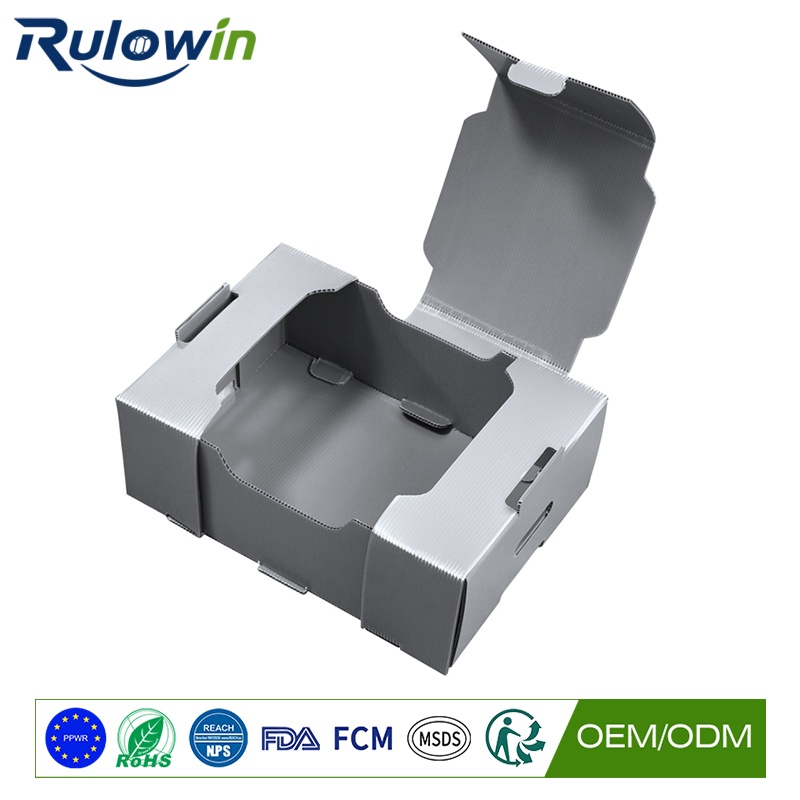
Empty produce crates take up an enormous amount of space relative to their weight, and in a packing house that space is usually the constraint. Nesting is the answer, and the details of how you nest determine whether you get the theoretical saving or about half of it.
Nesting vs stacking empty
Nesting means the crate drops inside the one below, so each additional crate adds only the wall thickness plus a small clearance. Stacking empty means one crate sits on the rim of another, adding the full crate depth each time.
The difference is usually a factor of five or more in height for the same number of crates. If you are stacking empties rather than nesting them, that is almost always the easy win.
The orientation matters
Most crates nest one way and stack the other – rotated 180 degrees, the same crate does both. Nesting them in the stacking orientation gives you a pile that jams and then, when pulled apart, breaks.
It is worth marking one orientation on the crate if your crew rotates. A paint mark costs nothing and it stops the wrong-nest problem permanently.
Height limits for nested stacks
A nested stack is stable to a reasonable height, and then it is not – it leans, and a leaning nest of crates falls over in a way that a stack of full crates does not. Keep nests lower than you think, and lower still if the floor is uneven or the crates are being moved by machine.
Storage of empties during a season is sized in working out crate fleet size for a season, and the empty-storage volume is usually the binding constraint in that calculation.
What breaks
Pulling crates out of a tight nest. The jam is real, someone yanks, and the rim or the handle cracks. A crate design with a positive stop prevents the jam; where there is no stop, tap the nest sideways rather than pulling vertically.
Wet crates
Do not nest wet crates. They nest, they stay wet, and the inside of the nest grows biofilm. This is the single worst thing you can do with an empty crate and it happens constantly because nesting wet crates is also the obvious thing to do.
Washing and drying without a rack is covered in washing produce crates without a drying rack.
Racking versus block stacking
Block stacking nested crates on the floor is cheap and uses the floor you have. Racking uses the volume above it, and for a site where floor is the constraint it is worth the capital.
The comparison is straightforward: work out how many crates you hold per square metre each way, and what the racking costs per crate stored. Above a certain fleet size racking wins clearly.
And what not to do
Do not build nests taller than you can reach safely. A nest that has to be climbed to be used is a nest that gets knocked over, and a falling stack of crates is a genuine hazard rather than a tidiness problem.
What we can do
We make PP crates for fruit and vegetables and will tell you the nesting pitch for each design, which is the number that decides how many you can store. Tell us your empty-crate space – we will tell you whether a different crate would double it.