
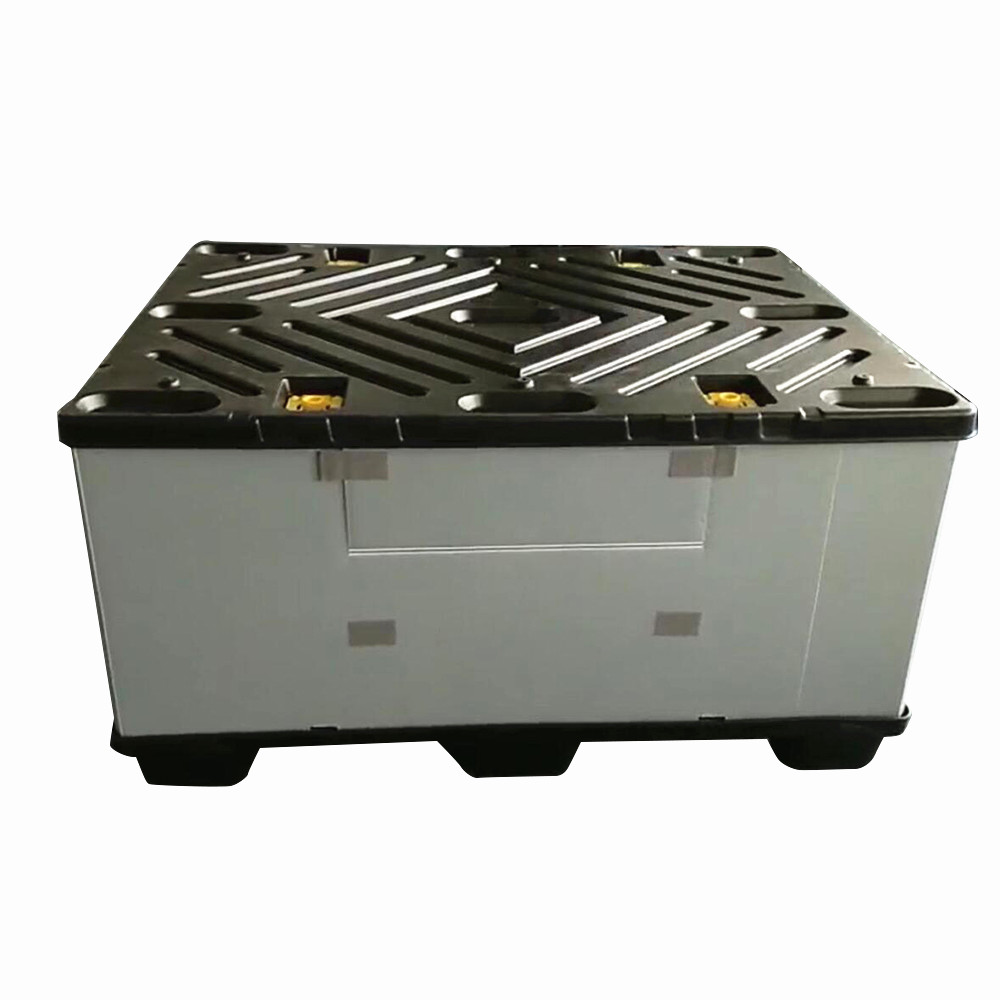
A pallet sleeve box collapses flat, which is the whole point of the design, and a collapsed box takes a fraction of the space of an assembled one. How much of that advantage you actually get depends on what you do with the lid and the base.
What collapses and what does not
The sleeve folds flat. The base and the lid do not – they are rigid mouldings. So a collapsed box is still a flat sleeve plus two rigid parts, and the rigid parts are what take the space.
The lid usually nests or stacks on top of the collapsed sleeve, and that is fine. The base is the awkward one: bases stack, and the stack height per base is whatever the base depth is.
Keeping them together or separating them
Together if boxes go out and come back as complete units – one box, one sleeve, one lid, one base. Simpler to count and simpler to manage.
Separated if you consume them at different rates, which most fleets do. Bases and lids wear faster than sleeves, so a fleet holding complete sets ends up with a surplus of sleeves and a shortage of bases. Holding spares separately and assembling as needed is more efficient.
Stack height
A stack of collapsed sleeves with lids on top is stable and can go reasonably high. A stack of bases is also stable. A mixed stack – sleeve, base, lid, sleeve – is not, and it leans. Keep the stacks by part type.
How many fit on a return vehicle is a different calculation and it is set out in how many collapsed sleeves fit on a return truck.
Where fleets lose the advantage
By storing boxes assembled because there is space to do so. An assembled box takes several times the volume of a collapsed one, and a yard full of assembled empties is a yard that cannot hold stock. Collapsing on a schedule rather than when space runs out is the difference.
The second way is by collapsing them with the lid inside rather than on top, which makes the bundle awkward and thicker than it needs to be.
Outdoor storage of collapsed boxes
Fine, with one caution: a collapsed sleeve lying flat on the ground collects water in the fold and stays wet. Stand collapsed sleeves on edge, under cover if possible, or at least off the ground on a bearer.
Knowing how many you have
Count collapsed stacks rather than boxes. A stack of collapsed sleeves of a known height is a known number of boxes, and counting stacks at a glance is quick enough to be done weekly. Counting individual boxes is not, and therefore is not.
Put the number per stack on the racking. It converts a stock count from a morning into a walk.
One caution on the lid
A lid laid flat on top of a collapsed sleeve is fine. A lid standing on edge leans, and a row of leaning lids falls over. Store lids flat, in a stack, and they take very little room.
What we can do
We supply industrial returnable pallet sleeve systems and will tell you what a collapsed box actually measures, which is the number that matters for your storage. Tell us your empty-box space and we will tell you how many you can hold – and what to do when the answer is not enough.