
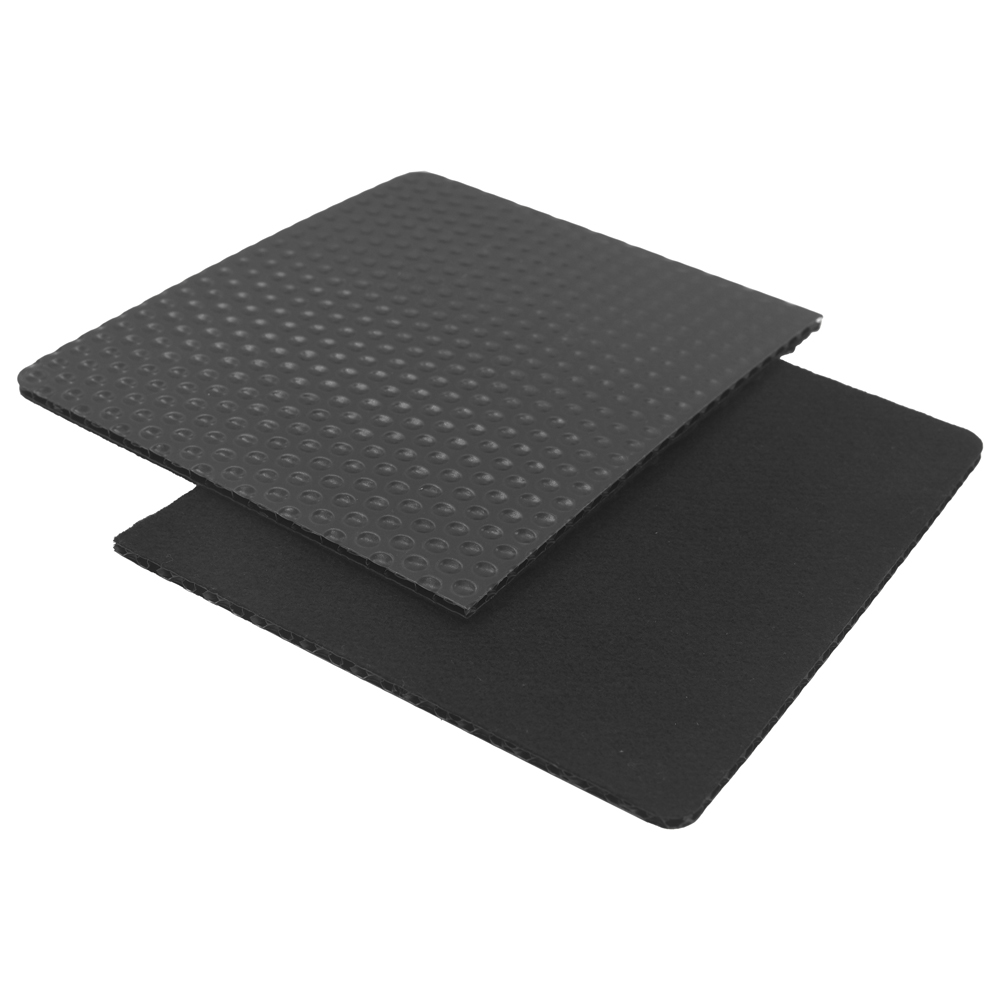
Both surfaces are polypropylene and both resist ink for the same reason, but they are not equivalent to print on. The difference is flatness and how the surface behaves under pressure, and it determines which printing method works.
Why PP resists ink in the first place
Low surface energy. Ink sits on top rather than bonding, and it rubs off. Every method that works on PP works by dealing with this – either by treating the surface first or by using an ink formulated for it.
Corona or flame treatment raises surface energy and is the standard approach for anything that needs to last. It is a process step rather than a choice of ink, and it is worth asking your supplier whether the surface has been treated.
What the honeycomb structure does
A honeycomb panel face is supported by cells, and over each cell the face is very slightly domed or, more often, very slightly depressed. Under a printing head that matters: a rigid screen or pad will not contact evenly, and the result is a print with visible cell pattern in it.
On a large solid area this is obvious. On text or a simple logo it is usually invisible. So the practical rule is that panels print well for marks and badly for large fills.
How flat sheet behaves
Corrugated sheet has flutes, which gives a different problem: a subtle stripe at the flute pitch. It is more regular than the honeycomb pattern and therefore easier to design around, and for most purposes it is not noticeable at all.
Sheet generally takes print better than panel, which is why most printed signage on PP is on sheet. The general question is covered in can PP sheet be printed on.
Methods, in rough order of durability
Screen printing with a PP-formulated ink, on a treated surface: durable, good for flat areas, and the most common industrial choice.
Digital UV: good for variable data and short runs, and the cured ink is hard-wearing. The cell pattern issue applies.
Thermal transfer or a printed label: the pragmatic answer for anything that changes – batch numbers, site names, dates. Not as durable, but replaceable.
Engraving or a stencil: permanent, ugly, and entirely adequate for identification marks.
What kills print on a reusable item
Abrasion, not adhesion. A printed panel in a return loop gets rubbed against other panels and against pallets, and the print wears off the raised areas first. A print that has to survive should be in a recessed area or protected by a clear coat.
What to tell the printer
That it is polypropylene, whether it has been surface treated, and whether the item is going to be washed or used outdoors. Those three facts determine the ink and the process, and leaving any of them out results in a print that fails.
How to test whether it will last
Stick a strip of strong tape over the dried print and pull it off sharply. If the print comes with it, the surface was not treated or the ink is wrong, and it will come off in service just as easily.
Do this on a sample before committing to a run. It takes thirty seconds and it is the test a printer should be doing anyway.
What we can do
We supply PP honeycomb panels and will tell you what surface finish and treatment suits your marking method. Tell us what you need to print and how the panel gets handled – if a label would serve better than printing, we will say that.