
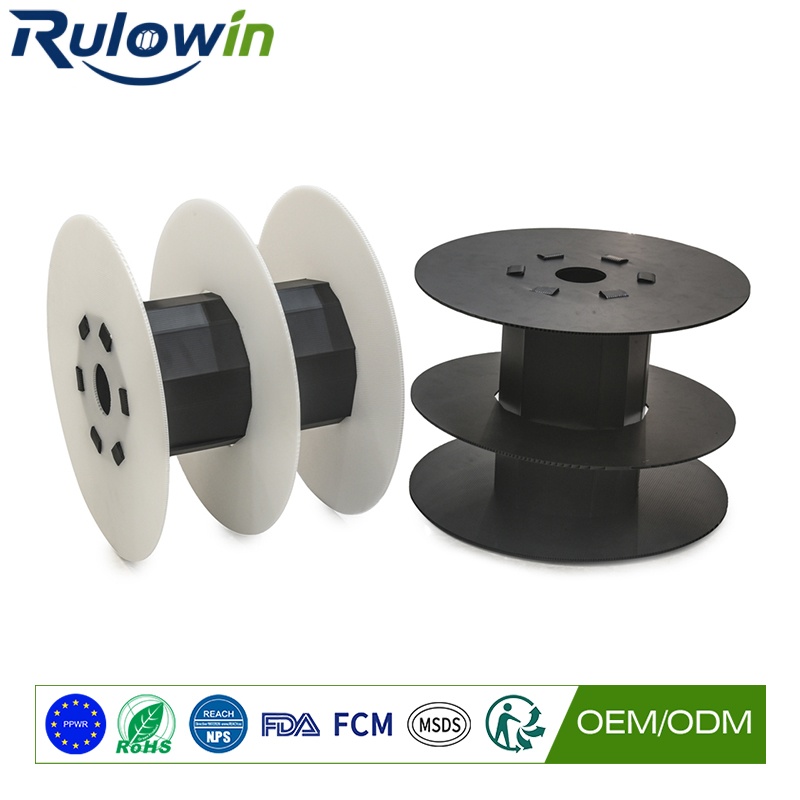
Cable reels come in two constructions: moulded as a single piece, or made as two flange halves and a hub that assemble into a reel. The obvious difference is that a two-piece reel can be taken apart, and the real question is whether that matters to you.
One-piece: what it does well
It is stiffer and it cannot come apart. That second point is not trivial – a reel that separates under load during a payout is dangerous, and it is a failure mode that only exists in assembled designs.
One-piece reels also hold their geometry better. There is no joint to work loose, and the hub-to-flange junction – where flange cracks start – is continuous material rather than a mechanical connection.
They are the standard choice for wound reels being shipped, and for anything being wound at tension.
Two-piece: what it does well
It knocks down. Two flange halves and a hub pack far more compactly than assembled reels, so the return volume of empties drops dramatically. For a reuse scheme on a long lane, that difference can be the whole business case.
Assembly is quick – the halves usually click or bolt together – but it is a step, and it needs to be done right every time. A half-engaged joint is a reel waiting to come apart.
Where the joint matters
The joint is the weakness. Under radial pressure from wound cable, the flange halves are being pushed apart, and the connection takes that load. On a fully wound reel at tension, this is a real force.
So a two-piece reel needs to be rated for the fill you intend, and that rating is lower than for an equivalent one-piece reel. Over-winding a two-piece reel is a faster route to failure than over-winding a one-piece one. We described the failure in why cable reel flanges crack near the hub.
How to choose
Ask whether empties travel. If reels are one-way or return assembled on a short lane, one-piece – it is simpler, stronger and there is nothing to assemble wrong.
If empties go back a long way and volume matters, two-piece, and accept the assembly step and the lower rating.
If reels are reused a lot and assembled many times, check the joint’s cycle life. A snap-fit that is fine for five assemblies may not be fine for fifty.
Assembly, and where it goes wrong
Two-piece reels fail at the joint, and they fail for one of two reasons: the joint was not fully engaged, or it has worn through repeated assembly.
Not fully engaged is a training issue. A joint that clicks is not necessarily a joint that is seated – worth showing a crew what seated looks and sounds like, and worth having someone check the first few of every batch.
Wear is a specification issue. A snap-fit has a cycle life and it is worth asking what it is. If your reels will be assembled fifty times, a bolted joint with replaceable hardware is often the better answer than a snap-fit rated for ten.
What we can do
We supply plastic reels for fiber cable production and deployment in both constructions and will tell you which suits your loop. Tell us whether empties travel and how far, and we will specify – including the honest rating for whichever design you choose.