
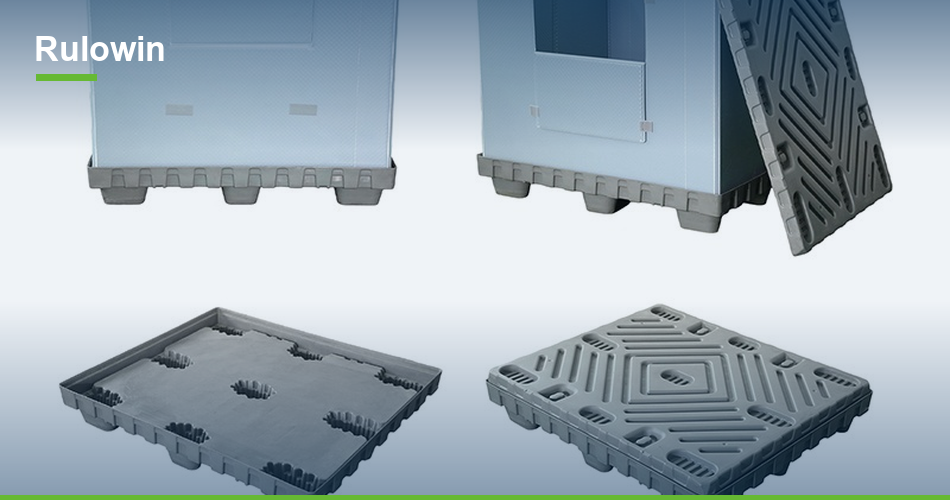
A pallet sleeve box turns a pallet into a rigid container without any tools. It is three pieces. A base sits on the pallet. A sleeve – a folded sheet with four corner creases – stands on the base and forms the walls. A lid goes on top. Loading happens between fitting the sleeve and fitting the lid.
When it is empty, the sleeve folds flat. That is the entire reason the system exists.
Why folding matters
An empty rigid container occupies the same space as a full one. A collapsed sleeve occupies a small fraction of it. So a truck that carried loaded boxes out can carry the empties back in a fraction of the space, which is what makes a reusable container viable on a long lane.
Everything else about the design – the creases, the material, the way the base locates the sleeve – is in service of that one property, plus enough durability to do it many times.
How it compares to what it replaces
Mostly it replaces wooden crates, and sometimes it replaces corrugated cartons on a pallet. Against a crate, it wins on weight, on return volume and on assembly time, and it loses on sheer abuse resistance. Against a carton, it wins on durability and loses on unit price. The cost comparison is set out in pallet sleeve box versus wooden crate, cost per trip.
What the parts are made of
Usually polypropylene – honeycomb or corrugated sheet for the sleeve, and a heavier moulded or fabricated base. The base is the part that takes the forklift and the floor, so it is built heavier, and it is the part that needs replacing first. Sleeves, bases and lids do not wear out at the same rate and should not be bought as sets.
We covered that in how many times you can reuse a pallet sleeve box.
When it is the wrong answer
When the empties will not come back. If boxes go out to customers and stay there, the whole return-volume argument disappears and you have bought an expensive carton. Also for very heavy or very abrasive loads, and for anything that is going to be handled roughly by people who do not own the box.
And when volume is very low. There is a minimum scale below which the administration of a return loop costs more than the boxes saved.
Variations worth knowing about
Two come up often. A drop-on sleeve, which slides over a loaded pallet from above rather than the load being built inside it – useful where product is already palletised and strapped. And a sleeve with an access flap, a cut and hinged section in one wall that lets an operator reach in without lifting the lid.
Access flaps are worth considering wherever a box is used for progressive loading or for picking, because lifting a lid every time is slow and a lid left off defeats the point of the box. The flap costs a little and saves a lot of handling.
Neither variation changes the basic economics. Both still depend on the sleeve coming back flat.
What we can do
We supply pallet sleeve box systems and quote base, sleeve and lid separately, because that is how they wear. Tell us the pallet footprint, load weight and height, and whether there is a return leg, and we will tell you whether the system pays – including when it does not.