
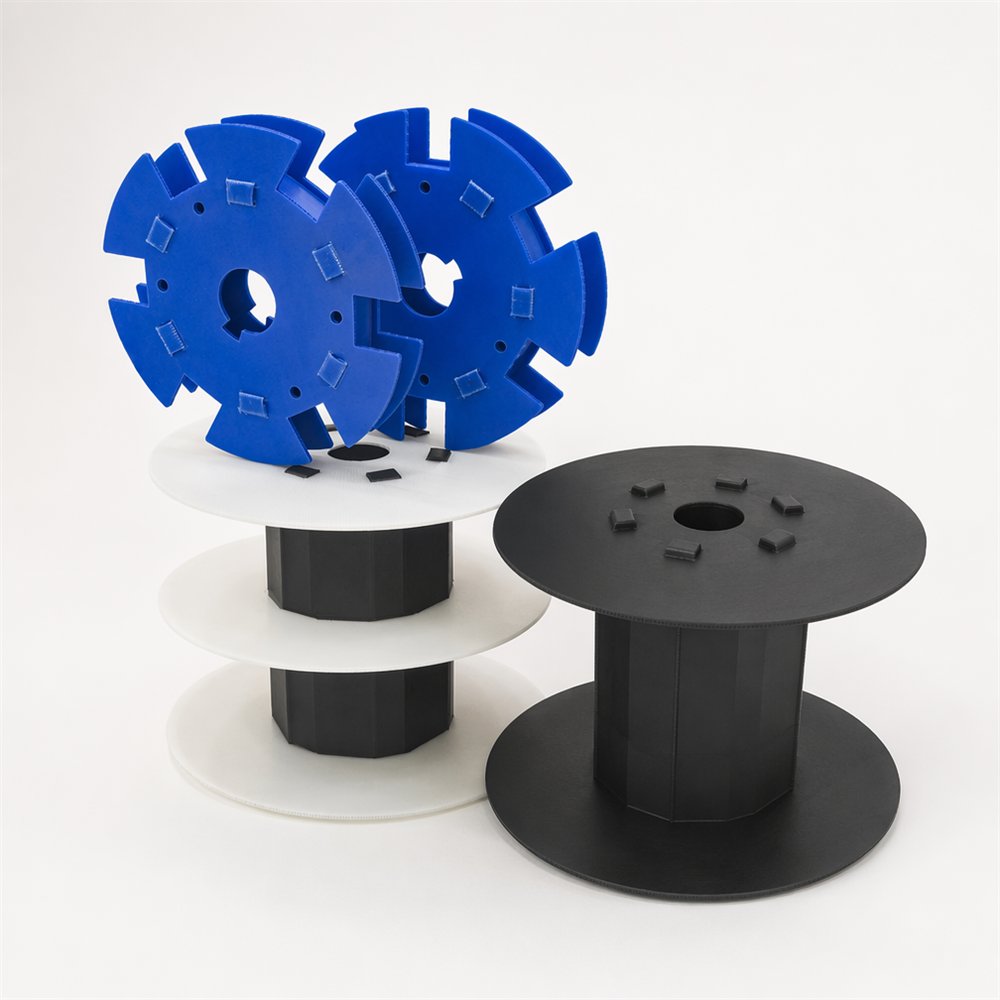
Sourcing reels looks like a commodity purchase and behaves like a specification exercise. There are three realistic channels and they are not interchangeable – they differ in minimum quantity, in how much you can specify, and in how much you learn about what you are buying.
Direct from the moulder
Best for volume and for anything with a real specification. You talk to the people who set flange thickness and hub bore, you can get changes made, and you can ask why a reel is built the way it is. Minimums are higher and lead times are longer, because you are waiting on production rather than on stock.
Also the only route if you want something that is not already in a catalogue – a specific bore, a reinforced hub, a particular balance.
Through a distributor
Best for small quantities and for speed. Distributors hold stock, they sell by the pallet rather than by the container, and they will take a mixed order. What you give up is specification: you buy what they stock. For standard sizes on standard cable, this is often entirely adequate and quicker than anything else.
The catch is consistency across reorders. A distributor’s stock comes from wherever they bought it, and the reel you get next year may not be the reel you got this year.
Through a trading company
Useful when you are buying several product lines and want one invoice and one container. The trade is information: a trading company is optimised for logistics, not for telling you why a flange cracked. If your reels are standard and nothing is going wrong, this works well. If you have a technical problem, it is the slowest route to an answer.
What to check whichever route you take
Hub bore against your payout spindle. Flange diameter against your cable’s minimum bend radius – we covered this in what flange diameter you need. Whether the reel is rated for the length you intend to wind, because over-winding is the most common cause of flange failure, described in why reel flanges crack. And whether the resin is UV-stabilised if reels will be stored outdoors.
Two questions that save the most trouble
Ask who made the reel. Not to bypass a distributor – there are good reasons to buy through one – but because the answer tells you whether anybody can answer a technical question when something goes wrong. “We do not know, it came in a container” is a real answer people give, and it means you have no route to a fix.
Ask what the reel is rated for, in writing, at your cable diameter. If you later have a flange failure and the rating was never stated, you have no basis for the conversation. Every serious supplier will put it in an email without being asked twice.
Lead times, and what actually drives them
Stock items ship in days. Made-to-order reels take as long as the production slot plus the freight, and the freight is usually the larger part. A reel specification that nobody stocks is a reel that takes two months, not two weeks.
Plan the first order around that. Most of the grief in reel sourcing comes from discovering the lead time after the cable has arrived.
What we can do
We manufacture PP fiber cable reels for optical communication applications and sell direct. Tell us the cable diameter, length per reel, bore size and quantity, and we will quote – and if your volumes are small enough that a distributor is the better channel, we will tell you that rather than stretch the minimum.