
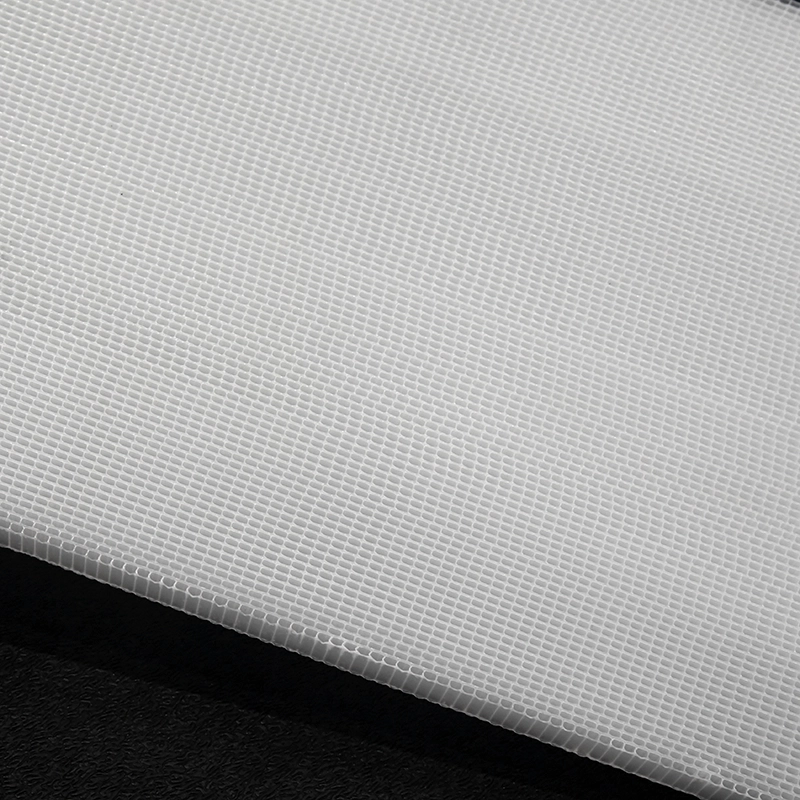
Filtration for a coarse stage can be bought as roll media that is cut and framed on site, or as finished rigid panels cut to size. Both are legitimate. The choice turns on volume, whether the size repeats, and who is doing the work – not on which material is better.
Where roll media wins
Cost per square metre is lower, and it adapts to any size on the day. If you have a workshop that cuts and frames, a range of sizes that changes job to job, and volume to justify holding stock, roll media is hard to beat on price.
It also absorbs error cheaply. A miscut piece of roll is a small loss; a miscut finished panel is a wasted purchase and a delay.
Where finished panels win
A rigid honeycomb panel needs no frame. It is self-supporting, it slides into a channel or sits against a face, and it does not need edge binding to hold its shape. That removes a fabrication step and, more importantly, removes the frame as a source of bypass and as something that can rust or warp.
Rigid panels also hold their geometry under airflow. A framed piece of flexible media can bow toward the fan under suction, and once bowed, it seals poorly at the edges and loads unevenly.
The repeat-order question
If the size repeats – and for plant maintenance it almost always does – finished panels become substantially easier. The specification is on file, the reorder is one line, and every panel is the same. With roll media, every cut is a fresh opportunity for variation.
Where sizes genuinely never repeat, the flexibility of roll media is worth more than the convenience of a repeat order.
The cost of framing
Roll media is cheaper per square metre and then needs a frame, and the frame is where the comparison usually turns. Framing material, the labour to cut and assemble it, and the fact that a framed panel is a fabricated item that can be made wrong – all of it belongs in the cost of the roll, not in a separate column nobody adds up.
There is also the frame as a failure point. It rusts, it warps, it can let go of the media, and it is the part that most often causes bypass in a framed panel. A rigid honeycomb panel has no frame at all, which removes the failure mode as well as the cost.
Waste and offcuts
Roll media generates offcuts, and in a plant with many odd sizes the offcut rate can be significant. It is worth tracking for a few months if the comparison is close – the difference between a neat nesting arrangement and a wasteful one is often larger than the difference in material price.
One question that decides it
Ask how many different sizes you cut in a year and how many of each. Two sizes cut repeatedly point at finished panels. Twenty sizes cut once each point at board. Most operations are somewhere between and the honest answer is often to do both: finished panels for the sizes that repeat, board for everything else.
Where the answer is unclear, start with board and keep a cutting log. After a year the log tells you which sizes repeat, and those are the ones worth ordering finished. It is a cheap way to find out rather than guess.
What we can do
We supply finished PP honeycomb filter panels cut to size, and we hold the specification on file for repeat orders so the second batch matches the first. Tell us the aperture, the airflow and whether the size will repeat, and we will tell you honestly which route costs you less.