
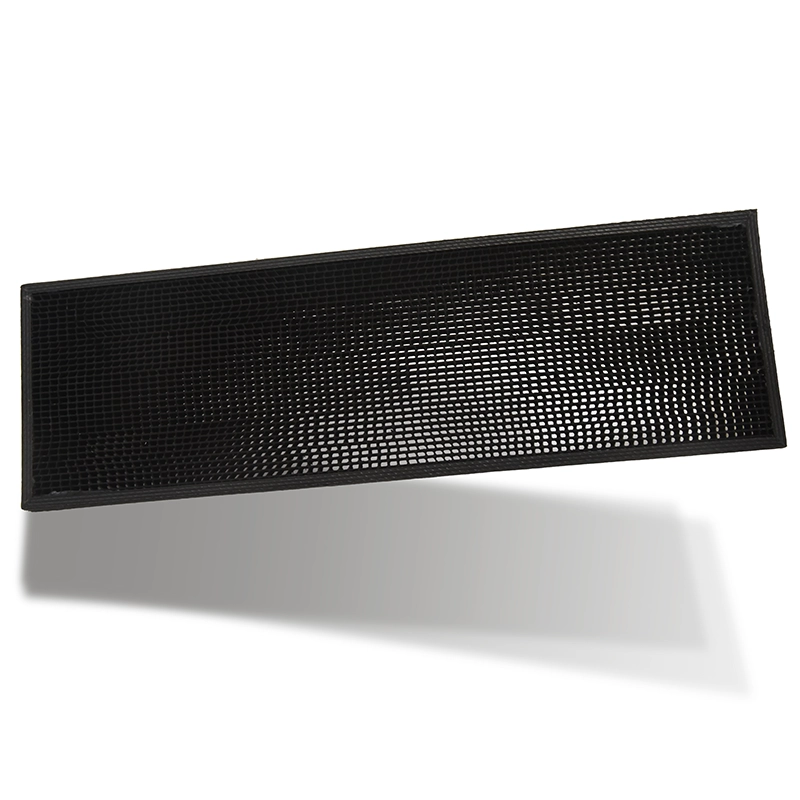
The reason a honeycomb filter screen can carry a useful amount of captured material while keeping resistance low is structural rather than material. Air passes through open cells; capture happens on the cell walls. The flow path stays open as loading builds, which is a different behaviour from a mat or a mesh that progressively closes.
Two ways to catch a particle
A fibrous mat catches by depth: particles penetrate and are held within a thick tangle of fibres. It is very effective and it fills up – the captured material occupies the same space the air needs, so resistance climbs steadily from the moment loading begins.
A mesh or screen catches on its surface, at the openings. It does not fill in the same way, but a fine mesh presents very little capture surface and blocks quickly at the face.
A honeycomb structure sits between the two. The cell walls present a large amount of surface to the air moving past them, and the cells themselves remain open. Material builds on the walls and the air path narrows gradually rather than clogging.
What controls the trade-off
Cell size is the main variable. Smaller cells give more wall surface per unit of face area – more capture, more resistance. Larger cells move more air for less pressure and catch less. Nothing else in the geometry moves the balance as much.
Depth matters too, but with diminishing returns. Making a panel thicker adds wall surface and adds resistance roughly in proportion, so there is a practical thickness beyond which the trade stops being favourable.
Why the loading curve looks different
Because the flow path stays open, resistance rises more slowly with loading than for a mat. In practice that means longer intervals between washes and a lower average pressure cost across the interval. It also means the screen does not fail suddenly – it degrades, which gives you a usable signal to service on.
The honest limitation
None of this makes a coarse screen a fine filter. Honeycomb geometry is good at coarse material and poor below a certain particle size; the fine fraction goes straight through. If the requirement is fine capture, no amount of geometric cleverness substitutes for the right medium – which is why these screens are specified as a stage, not as the whole answer.
The capture mechanism itself is set out in how a honeycomb grid separates air from dust.
Surface area relative to face area
The useful way to think about a honeycomb panel is how much wall surface it presents per unit of face area. That ratio is what determines capture for a given cell size, and it is why a honeycomb structure outperforms a flat perforated sheet at the same open area – the perforated sheet has almost no wall depth, so particles pass the openings without contacting anything.
Depth increases the ratio and cell size changes it: smaller cells pack more wall into the same face. Both raise capture and both raise resistance, which is where the trade-off lives.
What it means for washing intervals
Because the flow path stays open as material builds on the walls, the interval between washes is governed by how much the cells have narrowed rather than by how dirty the panel looks. In practice that means a honeycomb screen can carry considerably more material than a mesh of the same open area before it needs attention – and, usefully, that it gives warning. Resistance rises gradually rather than the screen suddenly blocking.
What we can do
We supply high airflow honeycomb filters in a range of cell sizes, and we will ask what you are trying to catch before recommending one. Tell us the airflow, the face area and the particle range and we will tell you what geometry suits it – or that your requirement needs a different stage.