
A filter’s purchase price is visible and its pressure cost is not. That asymmetry is why the wrong screen stays in place for years: nobody sees the energy it costs. Over a continuously running air system, the pressure cost of a coarse stage is usually larger than the consumable cost – and it is paid every hour whether or not anyone is thinking about it.
The mechanism
To move a given volume of air against more resistance, a fan does more work. On a constant-speed fan that generally means more current; on a variable-speed system it means a higher speed setting to hold the same volume. Either way the energy is real and continuous.
The size of the effect depends on how many hours the system runs. A plant running eight hours a day and one running around the clock differ by a factor of three, and the same filter’s pressure cost differs by the same factor. Continuous duty is where resistance matters most.
Why coarse stages are worth attention
Fine stages get specified carefully because their efficiency is the point. Coarse stages are often bought on price, and the pressure difference between a well-designed open structure and a dense cheap mesh can be substantial – enough to matter over years, and enough to show up in the margin the fan has left.
The other reason is that a coarse stage loads. A screen whose pressure drop climbs steeply as it picks up material costs more over its service interval than its clean reading suggests. Resistance as it loads is the number that matters, and it is rarely quoted.
How much is worth spending
It depends entirely on hours and on local electricity cost, and anyone quoting a payback without both is guessing. What can be said generally: on continuous-duty plant, a coarse stage that costs a little more and holds its resistance as it loads is usually the better buy. On intermittent duty in a lightly loaded space, it may not be.
The honest limit
Reducing resistance always trades against capture. A screen that adds almost nothing will also catch almost nothing, and there is no geometry that escapes this. The goal is the most capture per unit of resistance for the fraction you are trying to catch – coarse material, caught in a structure that stays open – not the lowest number on its own.
Where the saving actually appears
Fan power rises steeply with the volume a fan has to deliver, and delivering that volume against more resistance costs more work. The practical consequence is that resistance and hours multiply: a stage costing an extra fifty pascals on a plant running around the clock is a different proposition from the same stage on a plant running office hours.
It is also worth noting that the average matters more than the clean figure. A screen whose resistance doubles by the end of its service interval costs, over that interval, roughly the average of the two – not the clean figure that got specified. This is why the loaded number is the honest one to compare.
The honest limit
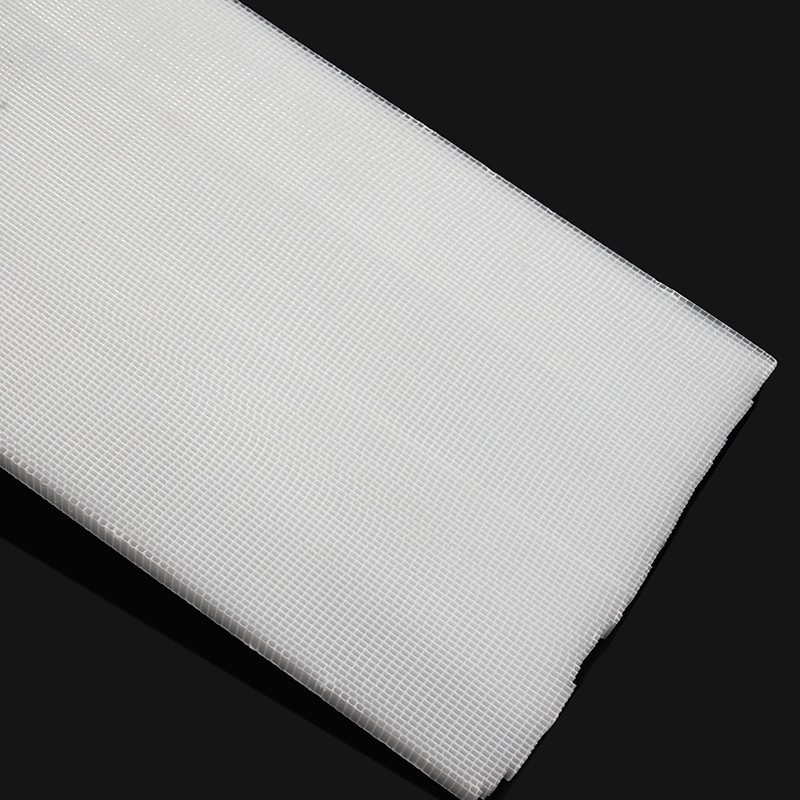
None of this means buying the most open screen available. Resistance bought down to almost nothing also buys almost no filtration, and a coarse stage that catches nothing has no reason to exist. What you are comparing is capture obtained per unit of resistance – and on that measure a well-chosen honeycomb geometry does well, while a denser cheap mesh does badly.
What we can do
We supply low pressure drop washable honeycomb filters and will quote clean drop and the figure as it loads, at your face velocity. Tell us the airflow, the hours and the face area, and we will tell you what the stage will cost to run – including where a cheaper screen would do the job just as well.