
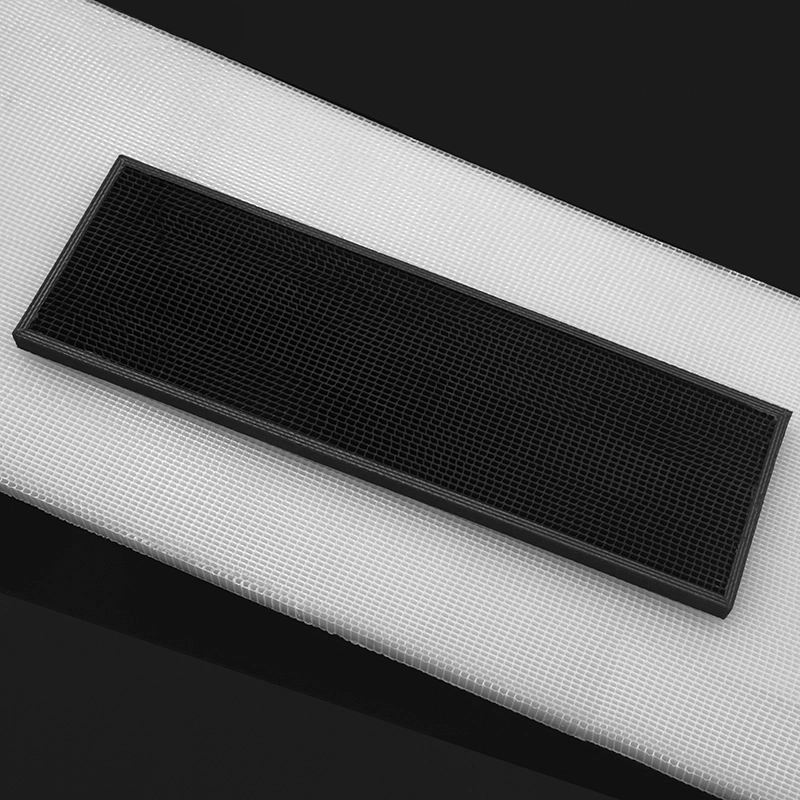
Filter holding frames are designed around disposable media: a cardboard-bound panel or a bag, sliding into a channel with a face seal. Putting a rigid washable panel into that arrangement is usually straightforward and fails in predictable ways when it fails.
Measure the frame, not the old filter
The dimension that decides everything is the clear opening and the depth behind it. Disposable panels are often slightly smaller than the opening and rely on their own compression to seal. A rigid panel cannot do that, so it has to be made to the actual aperture – close enough to seal, loose enough to slide.
Get this wrong in either direction and the result is the same: air takes the path of least resistance around the panel. Bypass is worse than a poor filter, because unfiltered air reaches the coil and the primary stage regardless of how good the panel is. A five percent bypass undoes most of the work.
Depth is the usual constraint
Frames built for a thin disposable panel often have little depth available. A washable honeycomb panel is thicker, and if it will not seat within the frame depth the door or clip will not close, or the panel will be forced against whatever is behind it.
Where depth is genuinely unavailable, the answer is usually to use the frame’s existing face but reduce the panel thickness, accepting a shorter service interval rather than forcing a fit. It is the compromise that actually works.
Sealing
Three arrangements, in order of reliability: a frame with a continuous face sealing surface; a clip or spring holding the panel against a gasket; and nothing, where the panel simply sits in a channel. The third leaks, and if that is all the plant offers, a retrofit panel needs a sealing flange added to bridge the gap.
It is worth checking the frame for distortion before ordering. Older frames bow, and a panel made to the nominal dimension will not seal against a bowed face.
Face area after the change
A thinner panel presents less media depth to the air. That usually means slightly lower capture of the coarse fraction and a shorter interval between washes, not a dramatic change. Where the plant has pressure margin, the better move is often to increase face area – a larger, shallower panel outperforms a smaller, thicker one on both resistance and capacity.
What to tell the supplier
Send the clear opening dimensions, the available depth, the design airflow and the material the frame is made from. Four numbers. Without the depth, any panel is a guess.
The fitting detail, panel by panel, is in fitting a washable screen into a standard HVAC frame; the measurement side is in measuring an opening, and why the seal matters is explained in edge gaps and bypass.
A checklist before ordering
- Clear opening measured at both ends, not taken from the old filter.
- Available depth at the tightest point, including brackets and housing curve.
- How it is retained: channel, clips, or pressed against a face.
- Whether the frame face is flat – hold a straight edge against it and look for gaps.
- Access: can a person actually get the panel out, and out again in six months with the plant running?
Photographs answer most of these faster than measurements do, and they catch the things nobody thinks to measure – a bracket in the way, a door that only opens part way, a frame that has racked.
What we can do
We supply PP honeycomb filtration panels cut to existing frame dimensions, and we will ask for the depth before quoting. Send us the opening and the airflow and we will tell you whether a retrofit works in your frames – and where it does not, we would rather tell you than ship panels that bypass.