
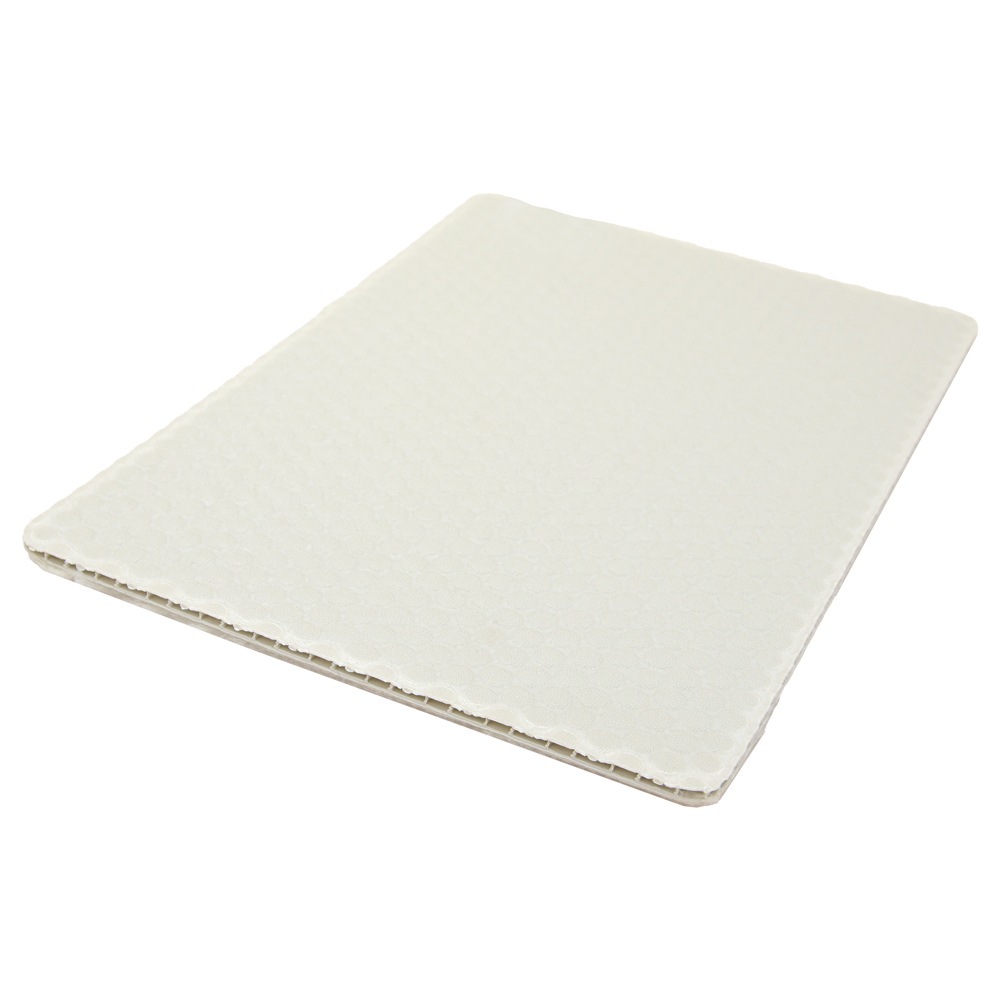
Load a PP panel briefly and it deflects. Remove the load and most of that deflection recovers. Leave the load on and something else happens: the panel keeps deforming, slowly, indefinitely. That slow continued movement under a constant load is creep, and it catches out more board applications than any other material property.
Why it matters
Short-term test data describes how the material behaves in the seconds and minutes after loading. Most board applications are not short-term. A shelf, a stacked pallet, a rack, a panel carrying equipment – these are loads that stay in place for months or years.
The consequence is that a design validated by a short test can pass comfortably and still sag visibly by the end of the season. Worse, the sag is usually blamed on something else: the wrong grade, a bad batch, a weak panel.
What drives it
- Load level. Creep accelerates sharply as the sustained stress rises. There is a level below which it is slow enough to ignore, and above which it becomes the governing factor.
- Temperature. This is the biggest multiplier. A panel that creeps slowly at 20 C may creep several times faster at 40 C, and a warm warehouse in summer can be 45 C near the roof.
- Time. Obviously – but the curve is not linear. It is typically fast at first and then slower, which means extrapolating from a week to a year by simple multiplication overestimates, while extrapolating from an hour underestimates badly.
- Support conditions. A panel spanning a wide gap creeps visibly; the same panel fully supported barely moves.
What it means for a shelf or a rack
Design for the deflected shape, not the initial one. If a shelf sags 15 mm over a year and that is acceptable, the design is fine. If it sags 40 mm and that makes the shelf unusable or makes product slide off, it is not – and no short-term test would have told you.
The practical levers are the usual ones: reduce the span, increase the thickness, or increase the skin gauge. Reducing the span is usually the cheapest, because stiffness falls steeply with span.
How to get a usable answer
Ask your supplier for long-term data, not just short-term strength. If they do not have it, run a loaded test yourself: load a sample to the sustained stress you expect, put it somewhere representative of the real temperature, and measure deflection over weeks. It will not give you a precise predictive model, but it will tell you whether you are in the comfortable region or the risky one.
Running the test warm is more useful than running it at room temperature, because it compresses the timescale.
Where creep does not matter
Short-duration loads. Panels used for transport dunnage that is loaded and unloaded within a shift. Anything where the load is applied and removed. In those cases the short-term properties are the right ones and long-term data is not worth waiting for.
What we can do
We will ask how long the load sits there, at what temperature, and how much movement is tolerable – those three answers decide whether creep governs your panel. Our PP honeycomb panels are available in several builds, and if your case is a long-span shelf in a warm building we will tell you the thickness that keeps the sag within your limit.