
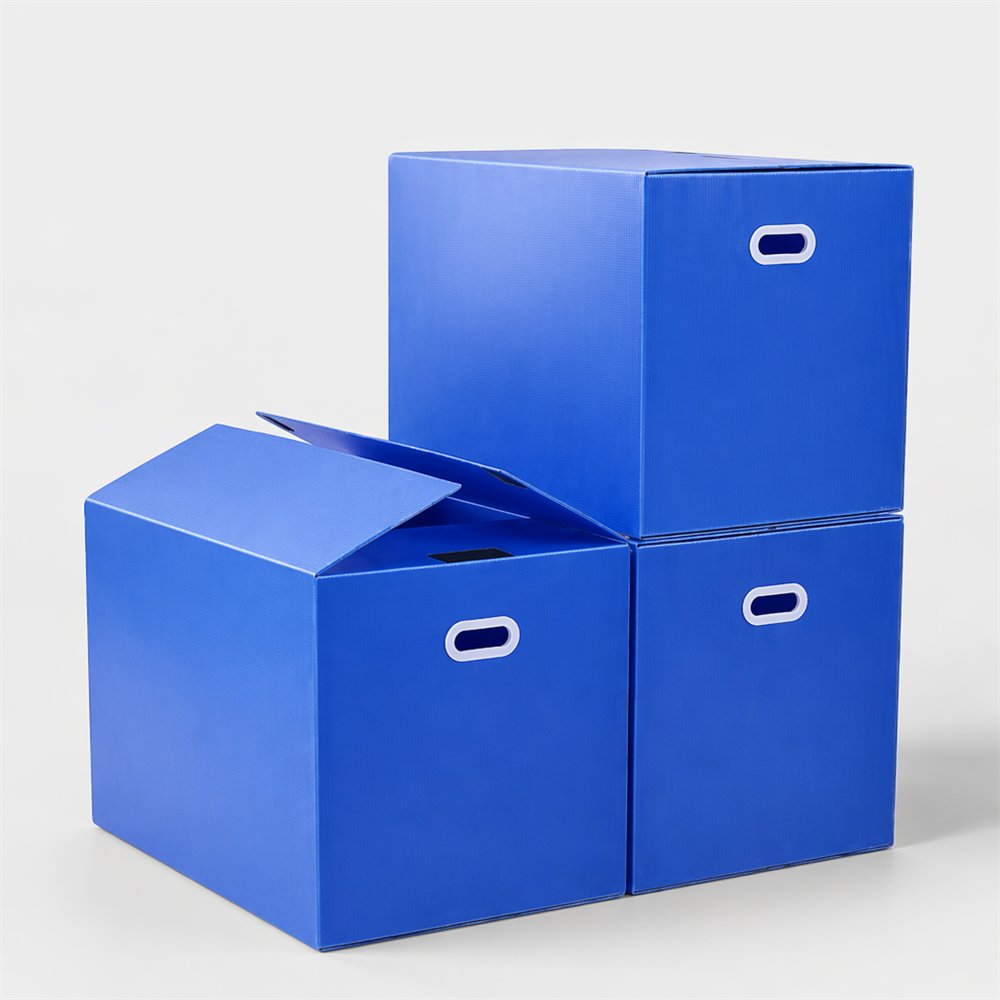
Corrugated PP turnover boxes sit between a carton and a moulded crate: lighter and cheaper than a crate, far more durable than a carton. They make sense in a specific set of circumstances, and buying them outside those circumstances is a common and avoidable mistake.
What they are good at
Repeated internal movement. Moving components between workstations, between a warehouse and a line, or between sites that belong to the same organisation. This is the natural application and where they pay back quickly.
Protection without weight. Better impact and moisture resistance than fibreboard, at a fraction of the weight of a moulded crate.
Collapsing when empty. Most designs fold flat, which makes the return and the storage of empties much cheaper.
Being replaced incrementally. They are cheap enough to buy in a rolling programme rather than as a capital project.
Where they are the wrong choice
Open loops. If the boxes leave your control and may not come back, you have bought an expensive carton. This is the clearest case.
Very heavy or sharp contents. Corrugated sheet has limits, and a moulded crate handles point loads and abrasion better.
Fully automated handling with tight dimensional tolerances. Moulded containers hold tolerance far better.
High-pressure washing at temperature on every cycle, which ages folded and glued constructions quickly.
Making a closed loop work
The loop is the hard part, and it is mostly process rather than product:
- A known population. You cannot manage what you have not counted. Number the boxes or at least count them at each transfer.
- A defined route back. Where do empties go, who moves them, and how often?
- A folding routine. Boxes that are not folded flat waste space and tend to get thrown away when space runs short.
- A repair or retire rule. Decide what condition is too damaged to keep using, and enforce it – a box with a split base will drop its contents eventually.
- Somewhere for empties to live that is not in the way, because if there is nowhere, they get skipped.
How long they last
In a disciplined internal loop, years. In a loop where they are dragged, left outside and overfilled, a fraction of that. The difference is handling rather than material, and the biggest single factor is whether empties are folded and stacked or thrown in a pile.
What to specify
- Weight capacity for both carrying and stacking
- Whether they are stacked when full and how high
- Folded height and whether the fold survives your cycle count
- Sealed edges if they are washed or used wet
- Antistatic grade for electronics work – see our article on ESD boxes
What to do with damaged boxes
Damaged boxes accumulate because no one wants to make the call. A box with a split corner still works, so it stays in service, and eventually it fails while it is being carried.
The fix is a simple rule that anyone can apply: a box is retired when the base is split, when a corner is open into the flutes, or when it no longer sits flat. Written down and communicated once, it removes the judgement call.
It is also worth having a visible place for retired boxes so that they leave the loop immediately. A box waiting for a decision is a box in use.
What we supply
We make corrugated PP turnover boxes for internal loops, with reinforced bases and sealed edges where needed. Tell us the route, the weight and whether the boxes stay inside your control, and we will tell you honestly whether this is the right product or whether a crate would serve you better.