
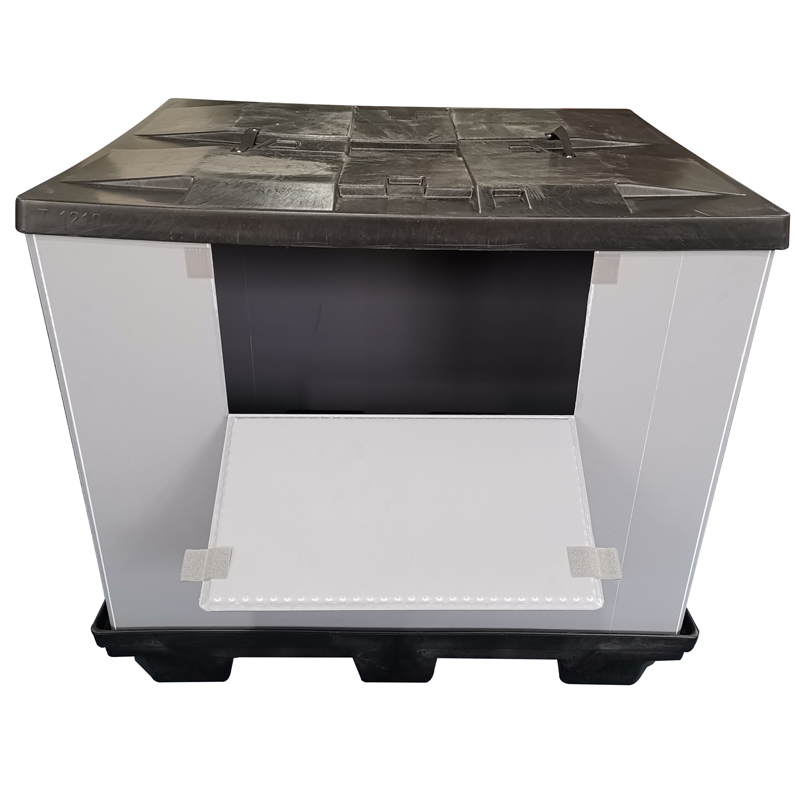
In a pallet sleeve system the sleeve is the part people evaluate, and the lid and base are the parts that fail. They take every forklift contact, carry the stack, and sit on the floor. Specifying them properly is most of the difference between a system that lasts and one that does not.
What the base has to do
- Carry the full load when the box is lifted and stacked
- Locate the sleeve so the corners engage and the walls cannot walk out
- Survive forklift contact from more angles than you would like
- Work with the handling equipment – two-way or four-way entry, and the right entry height
- Drain and be cleanable if the contents are wet or the environment is hygienic
What the lid has to do
Distribute the load from above. When boxes are stacked, the lid of the lower box carries the base of the upper one. A lid that flexes transfers point loads into the contents, which is exactly what the system is meant to prevent.
Stay on. A lid that lifts or shifts in transit lets the sleeve spread at the top, which is usually the start of a bulging problem.
Restrain the sleeve top if it is designed to, which is the cheapest fix for wall bulge.
Where they fail
Fork entry damage. The most common by a distance. A missed entry splits the base, and once split it will not locate the sleeve properly.
Stacking misalignment. Boxes stacked slightly out of line put the upper base onto the edge of the lower lid rather than its surface.
Water retention. A base with no drainage holds whatever leaked, and a lid with a recessed top collects water in storage.
UV if empties are stored outdoors, which they usually are.
Material and construction
Moulded bases and lids are durable and expensive, with tooling. Fabricated ones from PP sheet are cheaper to tool and lighter, and less resistant to fork damage. For a high-cycle closed loop the moulded version usually wins on cost per trip; for lower volumes, fabricated is the sensible choice.
Either way, ask what happens when one is damaged. A system where a damaged base means replacing the whole unit is more expensive over its life than one with replaceable parts.
What to specify
- Entry type and height matched to your actual trucks
- Load rating for both stacking and lifting
- Whether they nest when empty, and the nested height
- Drainage and cleanability
- UV stabilisation if stored outside
- Spare availability as individual parts
Specifying the base for the truck, not the load
Base failure is almost always fork damage rather than overload, and it is usually a mismatch between the base design and the trucks in use. A four-way entry base used with a two-way truck, or a base with an entry height that does not suit the fork section, gets hit.
It is worth checking the entry height and the fork section against each other, and asking whether the operators can see the entry from where they stand. Poor visibility causes more damage than poor design.
Where damage is chronic, sacrificial runners or a reinforced entry lip cost little and absorb most of it. It is a cheaper answer than replacing bases.
What we supply
We supply complete pallet sleeve systems with bases and lids matched to the sleeve, and we sell the parts separately because they do get damaged. Tell us your stack height and handling equipment and we will tell you what the base needs to be – it is usually heavier than people expect.