
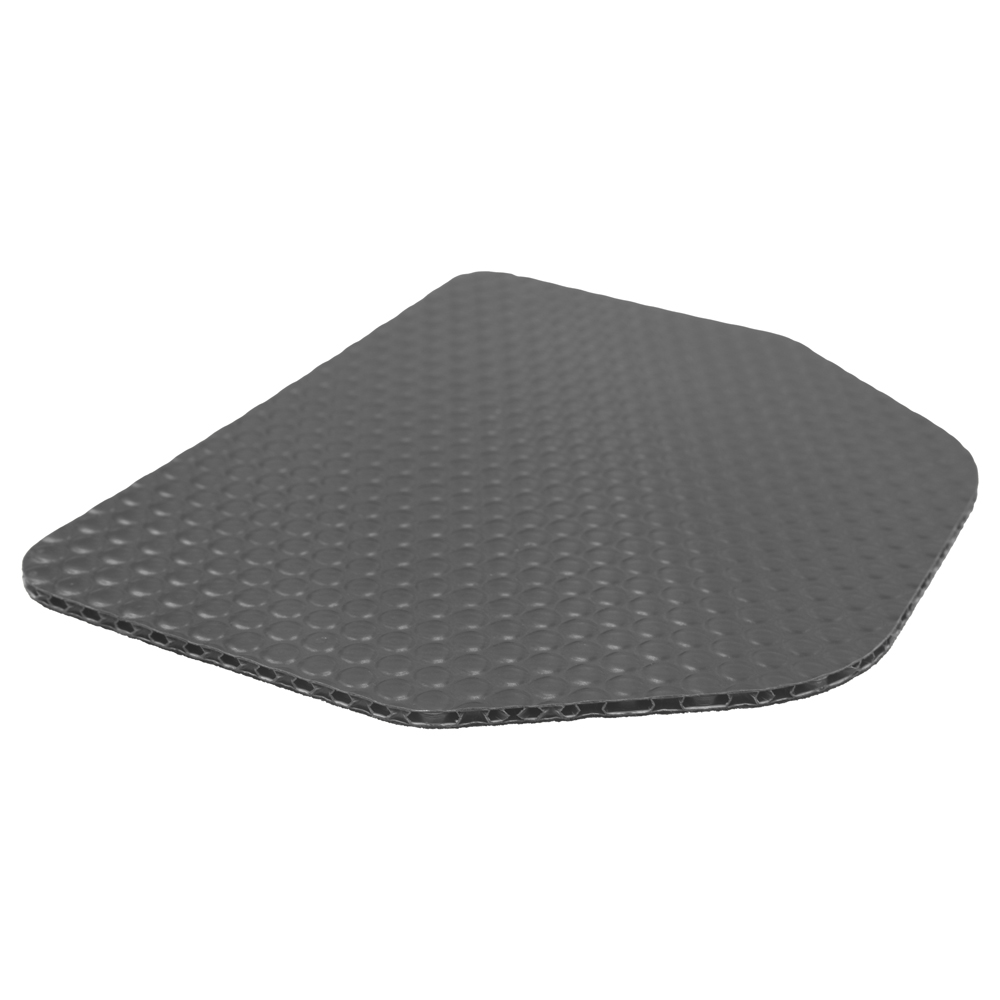
Ask for a 10 mm honeycomb panel and you will get quotes that look identical and perform differently. The variable doing the work is the skin gauge, and it is the specification most often left off the drawing entirely.
Why it gets left out
Partly habit – thickness is what gets measured on a delivered stack – and partly because a thinner skin makes a panel cheaper at the same headline thickness. If nobody specifies it, the quote drifts toward the lightest build that still looks like the number.
What the skin actually carries
In bending, the skins carry almost all the stress. The core keeps them apart, but the tension and compression live in the skins. Halve the skin thickness and you roughly halve the bending strength, even though the panel is still the same thickness overall.
That is the part that surprises people. A 10 mm panel with thin skins can be weaker in bending than an 8 mm panel with thick ones, and it will be much more vulnerable to everything below.
The failure modes a thin skin invites
- Denting. Anything with a small contact area – a part corner, a foot, a strap buckle – dents thin skin and the dent stays.
- Puncture. Sharp or heavy items pushed against the face will go through a thin skin and into the core.
- Delamination at the edges. A thin skin has less material bonded at the perimeter, and a cut edge starts to lift sooner under abrasion.
- Fastener pull-through. Screws and clips need skin thickness to grip. This is the one that shows up weeks later under vibration.
- Wash and heat damage. Repeated hot washing thins the effective skin over time through surface oxidation.
When a thin skin is the right call
Sometimes it genuinely is. A panel used as a one-way protective layer, a disposable pallet top sheet, or a short-life promotional board does not need a heavy skin, and paying for one is waste. The mistake is specifying thin skin on something expected to make dozens of trips.
How to specify it
Write it on the drawing as a minimum, in millimetres, alongside the total thickness. If you are not sure what you need, describe the abuse instead: what will be dropped on it, whether it gets strapped, whether it goes through a wash, how many trips you expect. That is enough for a supplier to propose a gauge.
How to check what you were sold
Cut a strip off an offcut and measure the skin with a calliper. It takes ten seconds and it is the fastest way to compare two quotes that claim the same panel. If a supplier will not state the skin gauge, that is information in itself.
What it does to cost and weight
Skin gauge is the main driver of material cost in a honeycomb panel, because the skins are where the polypropylene is. Moving from a thin skin to a heavy one can add a substantial fraction to the panel price and to its weight, which is why it drifts downward when nobody specifies it.
The useful question is where the extra material does the most good. In most service conditions it is worth spending on the face that gets abused rather than on both faces equally – an asymmetric build, with a heavier skin on the working side, often gives most of the benefit at a lower cost than upgrading both.
Whether that is available depends on the production method, so it is worth asking rather than assuming a symmetrical panel is the only option.
Where we stand
We quote skin gauge as standard on our PP honeycomb panels, because leaving it out makes the comparison meaningless. If you are comparing our quote against another one, ask the other supplier for that number – if the comparison changes once you have it, the original comparison was not telling you much.