
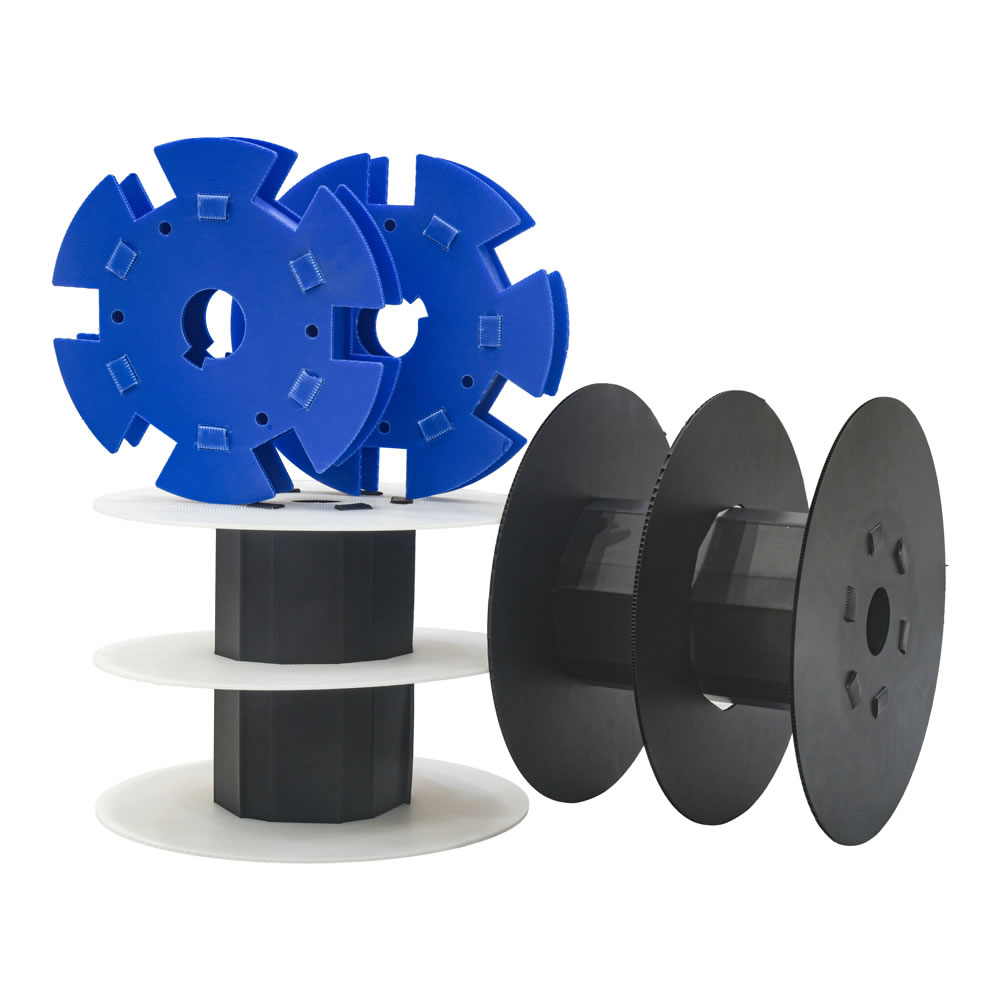
Packaging rarely appears in traceability planning. Product does, raw materials do, and the thing everything is sitting on usually does not. Then a question arrives — about a substance, a property, or a batch — and there is no way to answer it for the packaging.
The question you cannot currently answer
It takes a specific form: “these spools were made between these dates, from this material, and we need to know where they are.” Most operations cannot answer it, because:
- Deliveries are logged by date and quantity, not by batch
- Spools are not individually identified, so batch membership is not recoverable
- Stock is mixed in storage, so even a known batch is not physically separable
- Nobody has ever asked, so nobody has ever found out that the answer is no
How much traceability is proportionate
Full per-spool traceability with material genealogy is expensive and, for most spool applications, unnecessary. What is proportionate depends on consequence:
Low consequence — general industrial spooling, no regulated product. Delivery-level records are enough. Log date, quantity, supplier, purchase order, and keep a retained sample. If a question ever comes, you can narrow it to deliveries.
Medium — product with a specification of its own, or a customer who asks. Batch-level marking on the spool, either printed or colour-coded, plus delivery records tying batch to despatch dates.
High — regulated product, medical or food contact, or a contractual requirement. Per-spool identification, batch records, and the ability to identify which customers received which batch. This is a system rather than a record.
What to ask a supplier for
Reasonable requests, none of which should be controversial:
- Batch identification on deliveries. A reference on the delivery note, not just on an internal document.
- Material identification — what the spools are made of, at grade level.
- Notification of material change. This is the important one, and it belongs in a quality agreement — discussed in our article on quality agreements.
- Retention samples or at least a retained reference from each production run.
Change notification is the single most valuable of these. It is what stops a material change arriving silently and being discovered later as unexplained behaviour.
What to do on your side
Cheaply, and in rough order of value:
- Log deliveries with batch references where you have them
- Keep spools from different deliveries separated where storage allows, rather than consolidating immediately
- Record despatch dates against batches if you ever need to know who received what
- Mark spools with a batch reference if the consequence justifies it — the methods and their durability are covered in our markings article
The realistic limitation
Most reusable spool fleets are mixed within weeks of delivery, and no amount of record-keeping undoes that. If you genuinely need per-spool traceability, you need per-spool identification applied at introduction, and you need it to survive service.
That is achievable and it is also a real system with real cost. It should be a deliberate decision rather than an aspiration that quietly does not happen.
How this connects to substance questions
Substance declarations are only as good as the batch they refer to. If you make a declaration about composition and the composition changes, the declaration is stale — the point made in our article on what suppliers can honestly say, where the valuable commitment is notification of change rather than a static statement.
Practical minimum
If you do nothing else: record what you received, from whom, and when, and keep one spool from each delivery as a retained reference. That costs almost nothing and it converts “we have no idea” into “these deliveries” — which is usually sufficient for a real question.
Our position
For our hollow board spools we can identify material by grade, reference production against a delivery, and commit to notifying material changes. We can also apply batch marking where you need it, though it should be specified before production rather than added later.
What we will not do is imply a traceability system exists where it does not. If your requirement is per-spool genealogy, we will tell you honestly what we can support and what you would need to build around it.