
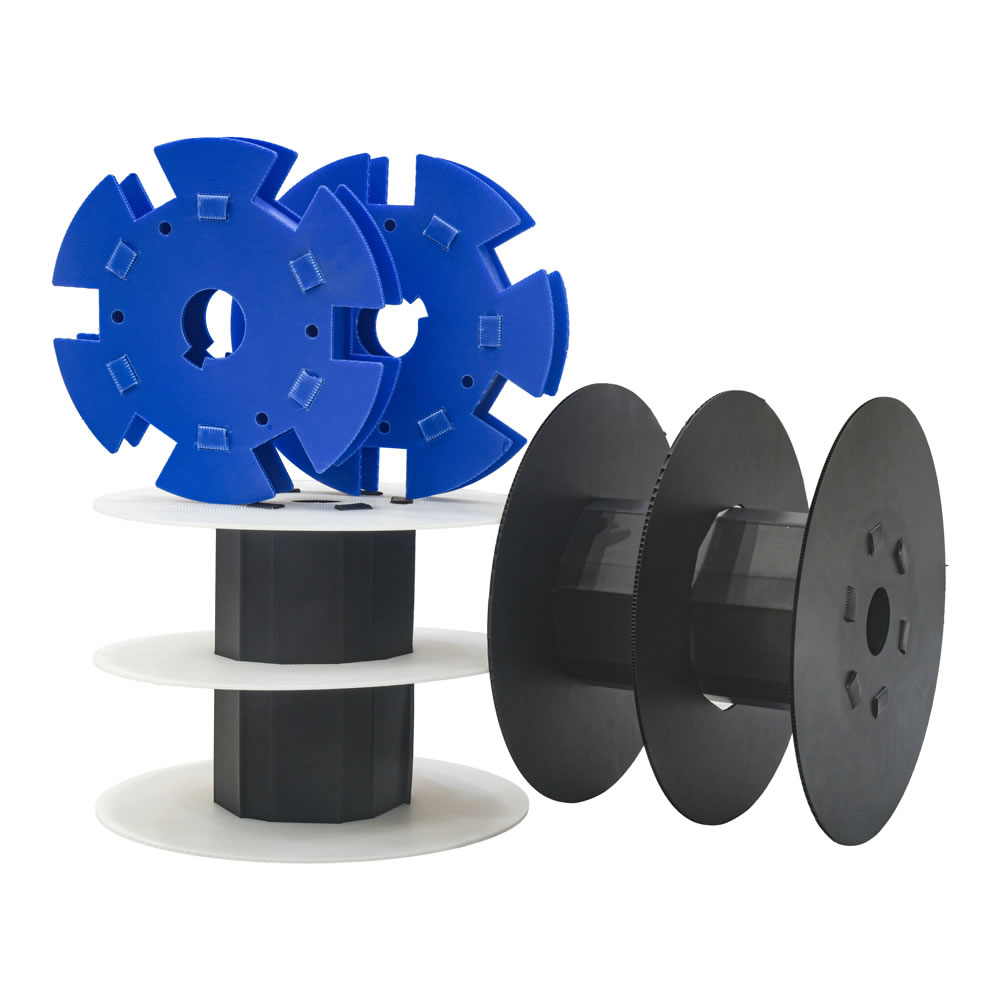
Mesh and fencing product arrives at the spool already assembled — wires joined, patterns formed, sometimes barbed. It has none of the uniform behaviour of a single conductor, and it is much better at catching on things.
What is different
- It is not round and not uniform. Crossings create thickness variation along the length, so no layer ever lies flat on the one beneath.
- It snags. Anything with a projection — and everything about a mesh has projections — will catch on anything it can.
- Contact pressure is concentrated. Load that would be spread over a smooth surface lands on crossings.
- It is abrasive at the crossing points in a way that uniform product is not.
Snagging is the dominant problem
Everything on the spool should be snag-free because everything on the product is a potential catch:
- No protruding fasteners or joint edges on the flange face
- No raised markings — see the discussion in our markings article, and specify flush if you can
- No exposed cut-outs in the flange, which are exactly what the general discussion in our cut-outs article warns about for this reason
- No lifted edges, lips, or delaminated edges at the rim
Run a hand over every surface the product can reach. If you can catch a glove, the product will catch too.
Compression at crossings
Because thickness varies, each layer rests on peaks rather than across its whole width. Contact pressure at those points is high even at modest overall tension.
What this produces: the lower layers take concentrated pressure at every crossing, over hundreds of layers. Depending on the product this results in flattening, distortion of the mesh geometry, or damage to any coating on the wire.
Lower winding tension helps. Larger core helps, because it reduces curvature at the base where pressure is highest. Fewer layers helps, which is a packaging-efficiency trade.
The core takes abrasion
Mesh sliding across a core as it winds is far more abrasive than smooth wire. Expect more core surface wear than you would get from the same weight of single wire, and inspect accordingly.
This is partly why the core surface discussion in our core construction article matters here — a wound tube with a visible seam is going to wear differently from extruded.
Barbed product specifically
Barbed wire behaves like wire until it does not. Barbs catch on each other and on anything else, and a tangle in barbed product is both more likely and worse to sort out. The principles from our bird-nesting article apply with the added factor that nobody wants to reach into it.
Extra clearance at the flange is worth specifying, because barbs reach further than the wire.
Storage
Mesh product stacked and compressed over time takes a set at every crossing. Stack lower than you would for uniform product and do not leave it indefinitely.
Is hollow board right for this?
Honestly, mixed. The advantages are a smooth snag-free flange surface with no splinters and no protruding metal, which is genuinely valuable here. The disadvantage is that hollow board has edges and internal channels, and if product can reach those it will find them.
The deciding factor is edge treatment. Specifying sealed edges removes most of the snag risk, and it is worth doing on this application rather than treating it as optional.
Send us what you are spooling and how heavy it is, and we will tell you honestly whether our hollow board spools fit or whether something with a fully closed surface serves you better.