
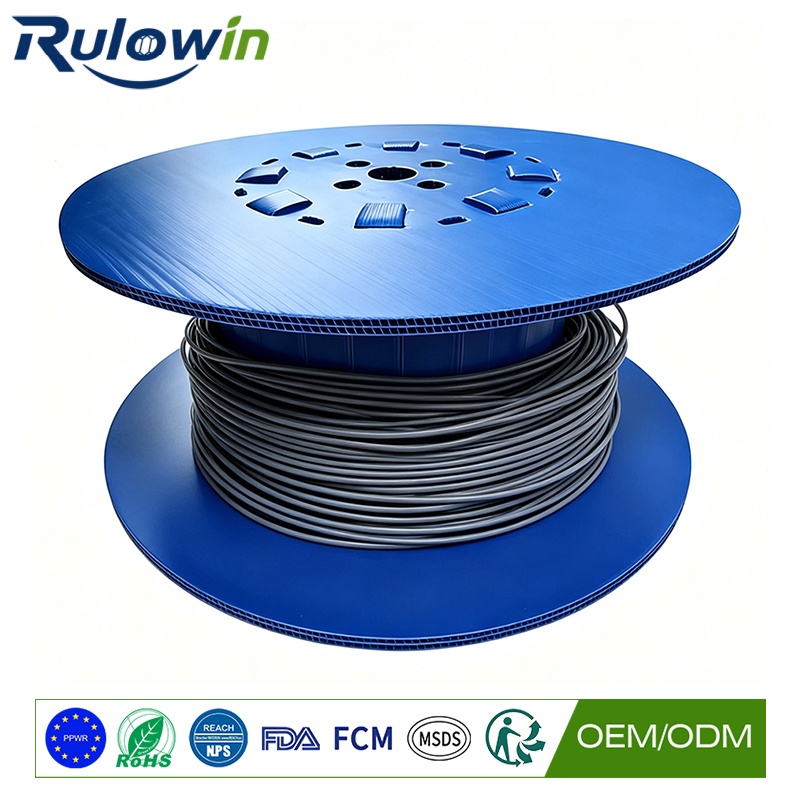
A spool comes back from a customer with a cracked flange. Somebody asks whether it can be repaired. The honest answer is that roughly 80 per cent of what we see is cosmetic and can be ignored, and most of the rest should be scrapped — and the instinct to try and fix the middle cases usually costs more than it saves.
Damage that does not matter
- Surface scuffs and scratches on the flange face. Unless they have cut deep enough to create a step the product can catch on, these are cosmetic. Run a fingernail across; if it does not catch, forget it.
- Discolouration or chalking from UV. Surface-level on a UV-stabilised board. It looks bad and means very little structurally in the early stages. If it has gone as far as surface cracking, that is a different category.
- Small dents in the flange rim. Provided the rim is still round and the dent does not intrude into the winding space.
- Dirt, labels, adhesive residue. Cleaning, not repair.
Damage that means scrap
- A crack that reaches from the rim towards the hub. This is the one to be strict about. The flange is carrying hoop load from the wound product, and a radial crack removes its ability to do so. It will not heal, and it will grow.
- A bent or distorted core. Any deformation of the core shows up as runout, and runout at speed destroys both the product and the machine’s patience. Do not attempt to straighten it.
- A bore that has wallowed out. Once the bore is oversized, the spool will not seat on the shaft, and no amount of shimming makes that reliable.
- A joint failure on a take-apart design. If the joining feature is damaged, the flange can separate under load. This is the failure mode with the worst consequences, because it can be sudden.
The tempting middle: welding it up
PP can be welded, so a cracked flange can in principle be repaired. We generally advise against it for three reasons.
First, the repair is unlikely to restore full strength, and the flange will fail at a lower load than before — probably at the repair. Second, the heat-affected zone around a weld is often where the next crack starts, particularly on a part that has already been UV-exposed and has lost some of its stabiliser. Third, and most practically: the labour and handling cost of collecting, assessing, repairing, and returning a spool usually exceeds the cost of a new one, unless the spool is very large or very expensive.
Where repair does make sense is on high-value spools where the flange is a replaceable component on a take-apart design. Then you are not repairing, you are swapping a part — which is a different and entirely reasonable operation.
A simple triage rule
We suggest something like this, applied at the point where spools come back rather than when someone is standing at the winding machine:
- Scrap anything with a radial crack, a bent core, a wallowed bore, or a damaged joint
- Use anything else, but mark it
- Re-inspect marked spools every few cycles; some defects grow, and catching them at inspection is much cheaper than catching them in service
Having a written rule matters more than the exact rule, because it stops the decision being relitigated by whoever is on shift.
Why “weld it and see” is the expensive answer
A spool that fails in service takes product with it, and product is worth far more than the spool. It may also take out a payoff, a dancer, or someone’s hand. The asymmetry is stark: the saving from repairing a spool is a few units of currency, and the potential cost is a scrap reel of cable or worse.
Our hollow board spools are priced as consumable assets within a multi-trip programme, which is what makes this arithmetic easy. If you are using spools expensive enough that repair genuinely looks attractive, it is worth asking whether you are using the right spool for the job.
Record what you scrap
Keep a tally, even informally, of why spools get retired. If it is dominated by one failure mode, that is a design or handling problem worth solving — and it is the sort of pattern you only see once you have written it down.