
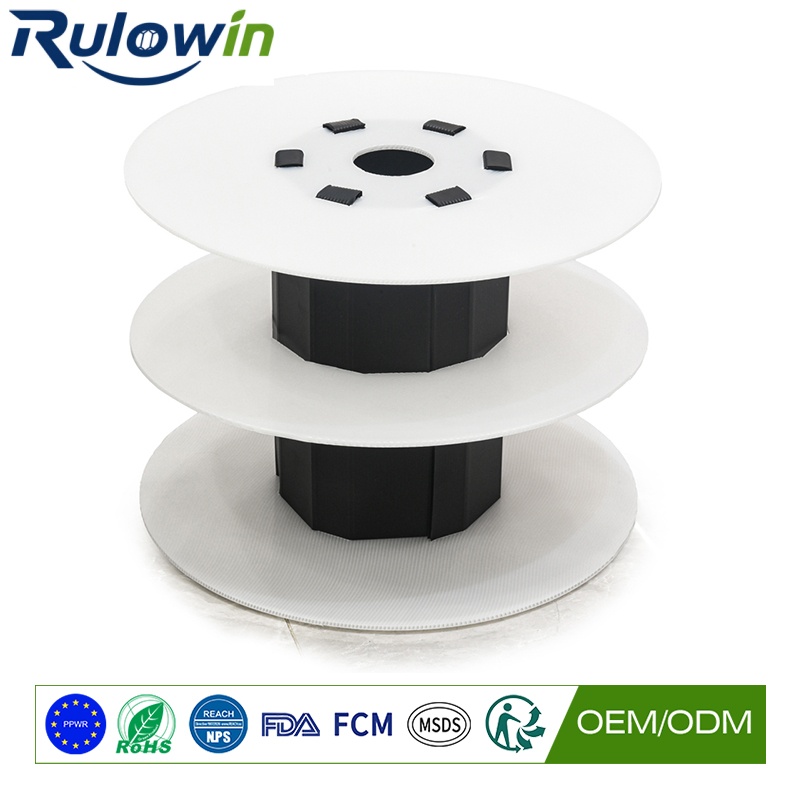
Filament spools are the odd one out in this series, because the person using them is not a machine operator with a tension controller and a load cell. It is somebody with a printer on a desk, and the spool has to work with no skill and no adjustment at all.
That shifts the priorities in ways that are easy to miss if you are used to industrial spooling.
Tangle is the whole problem
The filament tangle — where a loop slips under the layer above it and locks — is the dominant failure. It happens because filament is wound under low tension and the pack is loose enough for a turn to move. Once a turn has slipped under its neighbour, pulling tightens it rather than releasing it, and the spool is unusable.
Industrial winding avoids this with tension. Filament winding often cannot apply much tension, because the product is soft and will deform. So the prevention has to come from somewhere else:
- Consistent, moderate tension through the whole wind, with no slack at the end
- A traverse that leaves no gaps for a turn to drop into
- Keeping the pack away from the flange so there is less room for a loop to migrate
The flange, or the lack of one
Many filament spools are wound on a hub with minimal flanges, because the consumer printer feeds from the side and a large flange gets in the way. That works when the wind is good and fails spectacularly when it is not — a flangeless pack has nothing to contain a migrating loop.
If the design is flangeless, the wind has to be reliable. There is no fallback.
Friction and the payoff
Filament is pulled off by the printer’s extruder, which has limited torque. Too much friction in the spool — a rough hub, a spool that does not rotate freely on its holder — shows up as under-extrusion and print defects that the user will attribute to the filament.
The bore and the hub surface need to be smooth and dimensionally consistent, because the spool sits on a holder of varying design and something that binds on one holder will bind on many.
Moisture, which is the other half
Most filament is hygroscopic, and wet filament prints badly. The spool is usually the first line of defence, and it does two jobs: it holds the filament and, in many designs, it forms part of a sealed package.
Whether the spool material matters for moisture depends on the packaging: a spool inside a sealed bag with desiccant is fine whatever it is made of. A spool left open on a shelf is a different story — and in that case a material that does not hold water, and a design that does not trap it, both help.
What is genuinely different from industrial spooling
- No operator. Every failure mode that a skilled operator would notice and correct is a failure here.
- Slow consumption. A spool may sit partly used for months, which is exactly the condition that lets a wind defect develop into a tangle.
- Aesthetic expectations. It is a consumer product; it is judged on appearance as well as function.
- Price sensitivity. Sharper than in most industrial applications, and the spool is a visible cost.
Where the money should go
On the wind, and on the hub consistency. Both are process rather than material, and both are what actually prevent the failure that gets complained about. A cheaper spool with a reliable wind out-performs a better spool with an inconsistent one, every time.
If you tell us the filament type, the spool dimensions and how it will be packaged, we can recommend a hub and flange geometry and tell you what winding settings to start from — and what to test before committing to a run.