
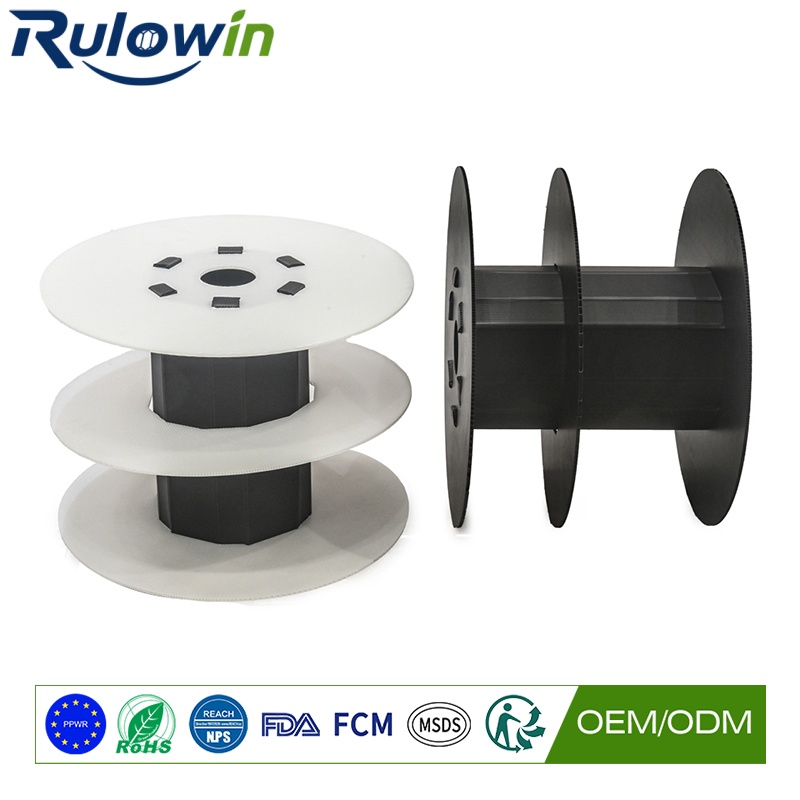
For medical tubing the spool stops being packaging and becomes part of the process. It touches a product that will go into a body, it sits in a controlled environment, and somebody in quality will want to know exactly what it is made of and how it was cleaned. That changes the specification conversation substantially.
Cleanability is the first question
Any surface the product touches has to be cleanable to whatever standard the process requires, and that rules out designs with features that trap material:
- Deep ribs with sharp internal corners
- Hollow sections that can hold liquid
- Joints and crevices on take-apart spools
- Any surface texture rough enough to hold particles
A smooth, radiused, single-piece design is easier to validate than a ribbed assembly, and it is worth sacrificing some stiffness for it. Where ribs are structurally necessary, generous radii and open profiles clean far better than tight ones.
Material and extractables
Polypropylene is a reasonable choice for medical contact — it is widely used, chemically stable, and can be supplied in grades with documented biocompatibility. What matters is documentation rather than the base polymer: you need to know the grade, any additives, and whether the supplier can support it with the declarations your quality system requires.
Ask for material certification as a matter of course. A supplier who cannot provide it is not a supplier for this application, and finding that out at qualification is better than finding it out at audit.
Cleaning validation
If spools are cleaned between uses, the cleaning process has to be validated like any other — which means the spool design has to be compatible with a validated process. A design that cannot be reliably cleaned cannot be validated, and an unvalidated cleaning process is a finding waiting to happen.
Practical implications: avoid absorbent materials, specify surfaces that can be inspected, and make sure the spool can withstand the cleaning agent and temperature repeatedly without degrading. Tell the supplier the cleaning method at the enquiry stage, not afterwards.
Traceability
Every spool should carry a permanent, unique identity, and the record behind it should cover material lot, cleaning history, and number of cycles. This is not optional in a regulated environment, and it is much easier to design in than to retrofit.
Moulded or embossed marks beat labels here, because labels are a contamination risk and they come off in washing.
Particle generation
Wear generates particles, and particles are a problem. Two design consequences: avoid product-contact surfaces that abrade against each other, and consider whether a take-apart spool’s joint is acceptable at all — every assembly cycle is a potential particle source.
Where a joint is unavoidable, specify its cycle life and inspect it as part of the routine.
What to ask a supplier
- Material grade with certification, and any relevant declarations
- Whether the design can be cleaned to your standard, and what evidence exists
- Cycle life under your cleaning regime, with data rather than assurances
- Permanent marking method and traceability support
- Whether they have supplied into a regulated environment before — the processes matter as much as the product
The honest caveat: this is a specialist application and not every spool supplier should be in it. If your requirement includes validated cleaning and full material traceability, say so at the start; it changes the design and the price, and discovering that late benefits nobody.