
Everybody quotes a trip target. Almost nobody gets one, and the reason is usually not the material. It is that the dunnage was designed as a shape that holds parts rather than as an object that will be handled roughly two hundred times, stored outdoors, washed occasionally, and dropped at least once.
Trip life is a design output. Here is where it is won and lost.
Corners take almost all of the damage
Look at a tray that has been retired early and the damage is almost always at a corner or along an edge. Corners meet the rack, the forklift, the floor and the other trays. They are also the place where two bonded or welded faces meet at a stress concentration.
Two things help more than anything else: generous external radii on every corner, and reinforcing the corner rather than the face. A tray with radiused corners and a corner block will outlast a heavier tray with square corners, because it sheds impacts instead of absorbing them.
The rack interface is under-designed
Dunnage rarely sits on a flat surface in service. It sits on rack beams, conveyor rollers, or the rim of the tray below it. The points where it meets those supports carry the entire load, and they are usually the last thing considered.
Design the support interface explicitly:
- Where does the tray land on the rack — full base, two beams, or four points?
- Is the edge supported, or overhanging? An overhanging edge on a loaded honeycomb panel is where crushing starts.
- What happens when it is placed slightly off? A tray that tolerates being set down 20 mm out of position survives; one that does not will crack at the beam contact.
Facing material decides surface life
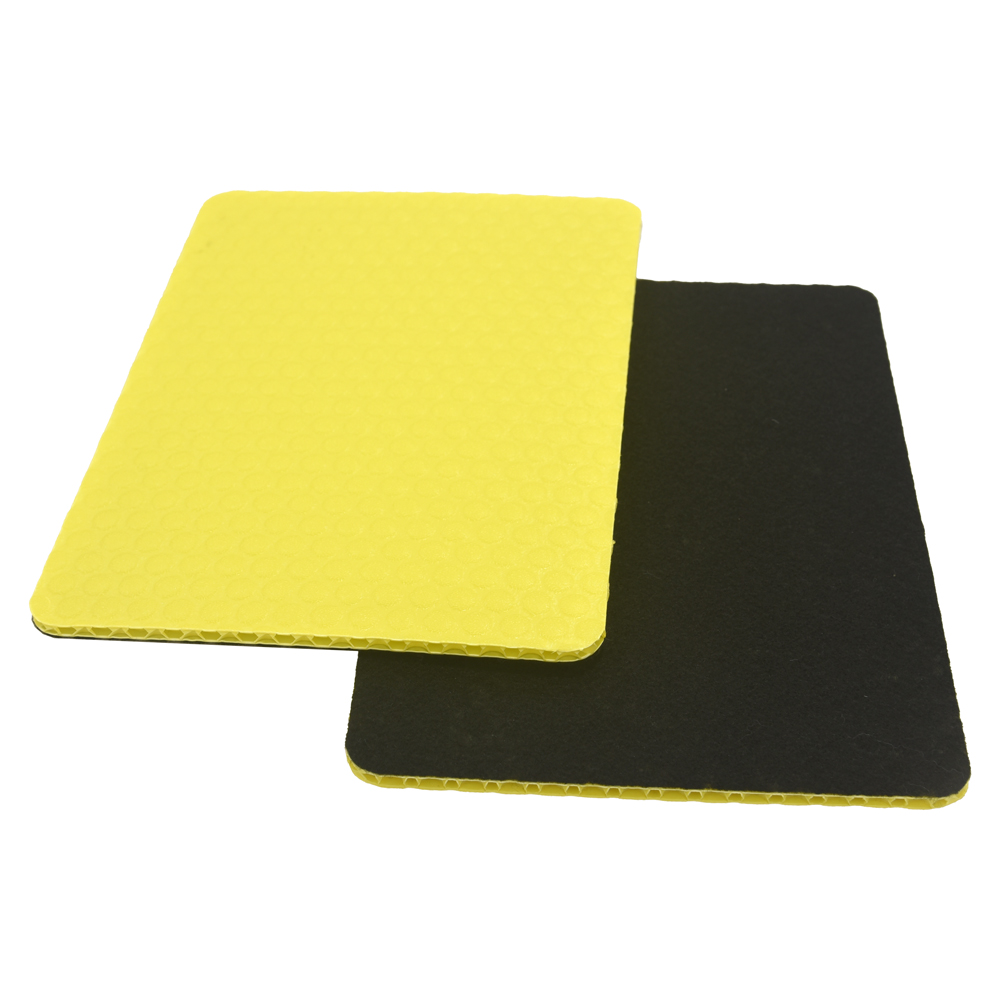
A bare honeycomb panel is a good structural material and a poor contact surface. The cell pattern can telegraph through to a soft part, and it abrades. Most automotive dunnage therefore uses a facing — a felt, a fleece, a closed-cell foam, or a second skin.
The facing usually fails before the structure does. Choose it on three criteria: abrasion resistance against the specific part it touches, behaviour when wet, and how it is replaced. A facing that can be peeled and re-applied locally turns a scrapped tray into a fifteen-minute repair, which is the single biggest lever on fleet cost over a couple of hundred trips.
Handling features that actually get used
Dunnage gets carried. If the design does not tell a person where to put their hands, they will grab the nearest edge, and that edge is usually the one carrying the load.
Handles should be formed where the load path is least critical, sized for a gloved hand, and positioned so the tray hangs clear of the body. If the tray is handled by a robot, the gripping features need to be on the drawing with tolerances — a robot does not adapt.
Identification is not optional
A fleet of two hundred identical trays is an unmanaged fleet. Moulded-in or welded-on identification — a part number, a customer code, a build date — makes it possible to track which trays are failing early and why. It also makes it possible to rotate stock, so the oldest trays are not always the ones on the worst route.
This sounds administrative. It is the difference between a fleet that degrades predictably and one that fails in clusters for reasons nobody can identify.
What to ask a supplier before tooling
- Expected failure mode, and at roughly what trip count. A supplier who cannot answer this has not tested.
- Whether the facing is replaceable, and how long a replacement takes.
- What happens if a corner is damaged — is there a repair, or is the tray scrap?
- Stack and nest behaviour when the tray is wet or contaminated, which is when it is hardest to separate.
- Whether the design has been run through the actual handling equipment, not just a drop test.
The honest part
A trip target is a forecast, and forecasts are only as good as the assumptions behind them — how the tray is handled, how often it is washed, whether it is stored outside, and how carefully it is loaded. A well-designed honeycomb tray in a well-run loop comfortably reaches a high trip count. The same tray in a loop where empties are thrown into a trailer will not, and no material change will fix that.
Design for the loop you actually have. If you want a second opinion on a specific tray, send the part, the handling flow and the target, and we will tell you where it is likely to fail first.