
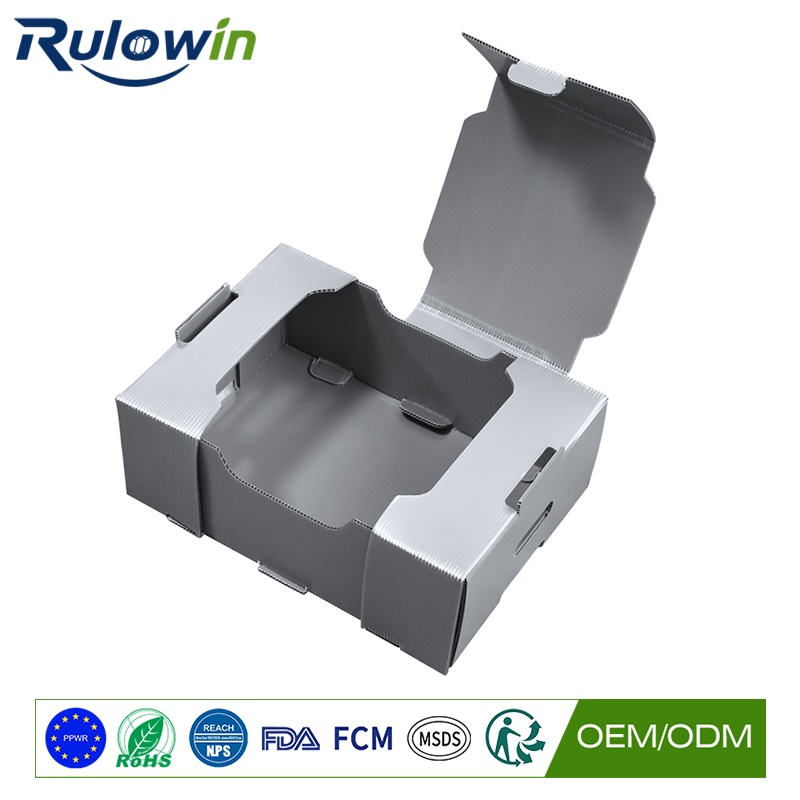
Sea Freight Is Harsh
A 30 day ocean voyage exposes cargo to humidity above 90 percent, salt spray, stacking loads, and rough crane handling. Packaging that survives a domestic truck can fail at sea. Rulowin designs returnable PP containers for exactly these conditions so they protect the goods out and still come home.
The export loop only pays if the box survives both directions.
Moisture and Corrosion Control
PP itself ignores water, but the contents may not. Sealed lids with gaskets keep spray out, and desiccant pockets inside manage internal humidity for metal parts. Unlike cardboard, a PP tote will not soften and collapse onto the product during a humid crossing. A machinery exporter using Rulowin sealed totes cut rust claims on sea shipments from 5 percent to under 1 percent.
Vent options balance corrosion control against mould risk for organics.
Stack and Shock Design
Containers must hold stack loads near 1,000 kg at the bottom of a 4-high pile and resist the shock of crane set-down. Ribbed walls and reinforced corners absorb this; living hinges keep lids attached through vibration. Sizes are tuned to the 20 ft and 40 ft container internal dimensions so a box count fills the hold with minimal void, raising cube use past 90 percent.
Blocking and bracing is simpler when every box is identical.
Managing the Return
Empty export totes nest to roughly a quarter height, so backhaul cost stays low on the return leg. A deposit or scan-based custody model ensures boxes are collected at the destination port rather than abandoned. One industrial exporter recovered 93 percent of a 7,000-box fleet across annual lanes, saving the equivalent of 21 trucks of disposable packaging. Design for the round trip, and sea freight becomes a reusable strength.
Durable by design, returnable by plan.
Rulowin recommends a vacuum or desiccant protocol matched to voyage length, because a 30 day trip needs more buffer than a 10 day one. A pump maker using a voyage-sized desiccant plan cut corrosion claims on Asia-Europe lanes from 4 percent to 0.7 percent.
At destination, nominate a return consolidator rather than relying on the carrier, since boxes left at a port disappear fast. One exporter contracted a single return hub per region and lifted recovery from 78 to 93 percent, the difference that made the reusable program pay.
Photograph the loaded container before sealing so the desiccant placement and blocking are on record if a claim arises mid-voyage. Rulowin’s identical-box format makes that photo a reusable template, turning a one-off precaution into a standing procedure that protects the claim.