
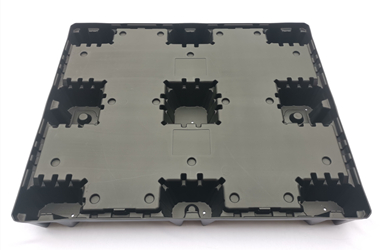
Why PP Outperforms Fiberboard in Wet Duty
Polypropylene is hydrophobic, absorbing less than 0.1 percent water by weight after 24 hour immersion in water, which is why it shrugs off the rain that destroys cardboard. Fiberboard loses 60 percent of its compression strength when saturated, which is why a cardboard box left in the rain becomes useless and a safety hazard that can collapse a stacked pallet on the floor without warning to the crew.
Rulowin validates every corrugated grade with immersion and condensation tests so buyers know the real-world margin they are purchasing, not just a lab claim on a dry sample that would never see a wet dock. The validation also lets us certify a grade for a specific lane, so a customer shipping through the tropics gets a board proven for that humidity rather than a generic one sized for a mild climate that would fail in the field.
Immersion and Weight-Gain Protocol
We cut coupons, weigh them dry, submerge for 24 hours at 23 Celsius, then reweigh to measure uptake precisely on a calibrated scale. A passing grade gains under 0.5 percent mass, which is negligible for the structural performance of the wall. The same coupon is then compression-tested to confirm the flute wall has not softened and lost the stiffness it needs to carry the stack above it on the pallet.
This two-step check separates true PP from filled blends that swell and lose strength, which protects the buyer from a cheaper substitute that looks similar on the shelf but fails in the field after a few wet cycles. The protocol is documented so the customer’s quality team can repeat it and verify a shipment matches the certified sample they approved before placing the volume order with us for the lane.
Condensation and Freeze-Thaw Cycling
Cold chain and outdoor storage expose boxes to condensation and ice that breaks weaker plastics by cyclic stress at the seam. Our cycle test runs 10 repetitions of minus 18 to plus 40 Celsius with 95 percent humidity, then inspects for delamination at the weld seam where the stress concentrates most during the temperature swing across the day and night on the yard.
PP copolymer passes 50 cycles without seam failure in Rulowin certification data, which gives confidence for year-round outdoor yard storage where cardboard would be destroyed in a single storm event and have to be replaced at cost. The freeze-thaw result also matters for refrigerated distribution, where boxes move between cold and warm rooms and the seam sees repeated condensation that would rot a glued cardboard joint within weeks of service.
Field Validation With Moisture Loggers
Lab data is confirmed with on-box data loggers during a 30-day lane trial on a real route that the customer actually runs with their product inside the container. Clients see the internal humidity curve and compare it to a cardboard control, which typically shows 30 percent higher interior moisture in the cardboard and a corresponding loss of protection for the goods inside the box during the transit.
That evidence supports the switch to reusable PP in wet lanes and gives the quality team a documented comparison to show auditors who question the material change on the line. The logger data also helps size the right grade, because it reveals the actual peak humidity the box sees, letting engineering specify a board that is adequate without being over-built and expensive for the conditions the lane really presents.